8 Best Agility Writer Alternatives for Affiliate Marketers and Niche Bloggers
Your content budget keeps growing while your output stays flat. Some tools cap credits, others bury bulk generation behind expensive tiers, and a few produce drafts that read like filler no affiliate link can save. That is usually the moment people start hunting for an Agility Writer alternative.
This article lays out the features that actually matter for affiliate marketers and niche bloggers, then compares 8 alternatives on modes, pricing, and scaling costs. By the end you will know which tool fits your workflow and why Autoblogging.ai takes the top spot.
What Affiliate Marketers and Niche Bloggers Should Look For in an Agility Writer Alternative
When evaluating an Agility Writer alternative, affiliate marketers and niche bloggers must prioritize tools that balance bulk content production with SEO precision and cost efficiency. These two audiences share a distinct set of pressures that general content creators often do not face.
Affiliate marketers typically manage multiple niche websites at once, each requiring a steady stream of product reviews, comparison posts, and buying guides. Niche bloggers face a similar challenge: they need consistent publishing volume to build topical authority, but they rarely have the budget or time to write every article by hand.
The economics are unforgiving. A single site might need dozens of posts per month to stay competitive, and a portfolio of sites multiplies that demand. Meanwhile, search algorithms reward depth, structure, and genuine usefulness, so thin or repetitive content rarely ranks for long.
That combination, high volume plus high quality plus controlled cost, is what makes tool selection so important. The right alternative should address these challenges through specific features and transparent pricing models, not vague promises about "AI-powered writing."
The criteria below break that evaluation into two practical areas: the features that determine output quality and workflow speed, and the pricing structures that determine whether scaling stays affordable. Readers comparing tools like Jasper AI, Copy.ai, Writesonic, Rytr, Article Forge, ContentBot, Simplified, Hypotenuse AI, Frase, or Surfer SEO should apply the same lens to each.
Key Features: Bulk Generation, SEO Modes, and Affiliate-Friendly Output
The most critical features for affiliate marketers and niche bloggers are bulk generation capabilities, advanced SEO modes, and output that naturally incorporates affiliate links and product mentions. Each one solves a different bottleneck in the publishing workflow.
Bulk generation is the first filter. A tool that produces one article at a time forces you to repeat the same setup steps over and over. Look for the ability to queue dozens or hundreds of articles in a single run, ideally from a list of keywords or titles. For a portfolio of niche websites, this is the difference between publishing daily and publishing occasionally.
SEO modes matter just as much. Strong tools offer SERP analysis, keyword optimization, and content briefs or outlines before drafting begins. Some work together with dedicated SEO platforms for deeper data. When comparing options, check whether the tool builds structure around search intent or simply generates fluent text that happens to contain a keyword.
Affiliate-friendly output is where many general-purpose writers fall short. The draft should accommodate affiliate links, product comparisons, pros and cons sections, and calls to action without heavy manual editing afterward. A review post that needs an hour of cleanup defeats the purpose of automation.
Practical metrics to compare across tools include:
- Articles or words generated per month on each plan tier
- Supported languages and whether output quality holds across them
- Integration options, such as WordPress publishing or SEO tool connections
- Access to current language models, since model quality shapes readability
- Editing controls for tone, structure, and formatting
Tools built on modern large language models tend to produce more natural phrasing, but features and workflow fit still separate a useful tool from a frustrating one. Evaluate each alternative against your actual publishing routine rather than its marketing page.
Pricing, Credits, and Scaling Content Costs
Understanding the pricing model, including credit systems and scalability, is essential to avoid overspending as content demands grow. Most AI writing software falls into one of three structures, and each behaves differently as your needs expand.
The most common structures are:
- Monthly subscriptions with a fixed word or article allowance
- Credit-based systems, where each generation consumes credits
- Pay-as-you-go options that charge per use with no recurring commitment
Credit systems deserve close attention. The conversion rate between credits and finished articles varies by tool and by article length. A plan that looks generous on paper may produce far fewer long-form posts than expected once credits are consumed per word or per generation. Before committing, estimate how many credits a typical 1,500-word review post actually requires.
Credit rollover is another detail worth checking. If unused credits expire at the end of each billing cycle, slow months waste money. Rollover policies make seasonal publishing patterns far more economical.
Scaling costs follow a predictable pattern. If you need 100 articles per month, a starter tier rarely covers it, and the jump to a higher plan can be steep. Map your realistic monthly output first, then match it to a tier rather than buying the smallest plan and upgrading repeatedly.
Transparency matters as much as the headline price. Watch for hidden fees, limits on seats or projects, and restrictions on commercial use, since affiliate content is commercial by nature. A tool that fits your budget but restricts how you can monetize output is not actually cheaper. Compare the full cost of producing one publishable article, including any manual editing time, before deciding which alternative earns a place in your stack.
1. Autoblogging.ai - Best Overall
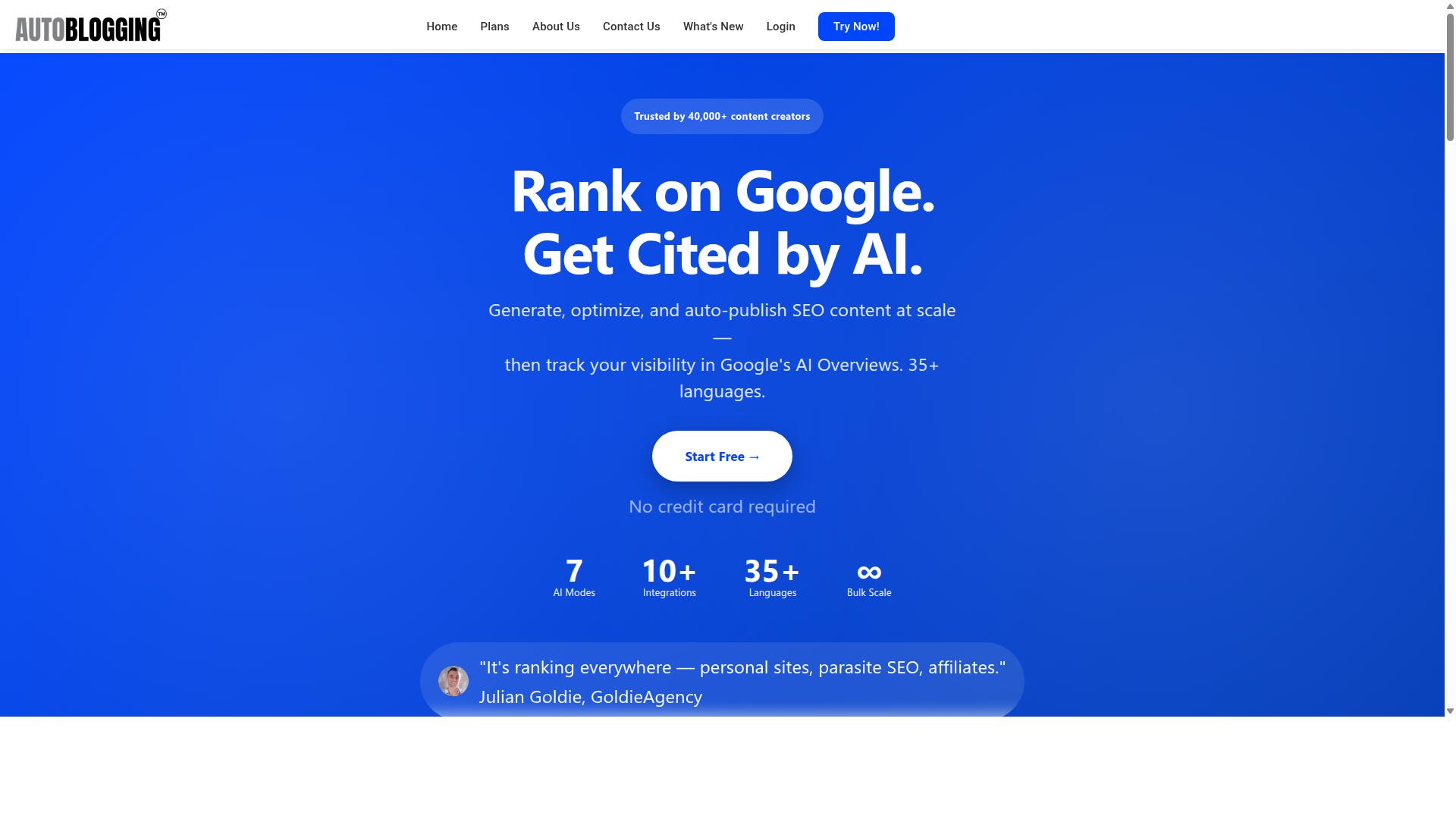
Autoblogging.ai earns the top spot for its blend of advanced AI modes, competitive pricing, and a proven track record with over 40,000 content creators. For affiliate marketers and niche bloggers comparing Agility Writer alternatives, it offers one of the widest feature sets in the AI writing software space.
The platform has generated more than 1 million articles and holds a 4.9 average rating from its user base. That combination of scale and satisfaction is rare among content generation tools, many of which excel in one area but fall short elsewhere.
What separates Autoblogging.ai is range. It ships with 10+ AI modes, supports 35+ languages, and connects with 35+ integrations. Few alternatives in this roundup match that breadth, especially at the entry price point.
For affiliate content specifically, the platform covers the full workflow: keyword research, SERP analysis, long-form articles, product reviews, and publishing. Niche bloggers can move from an idea to a scheduled post without juggling multiple subscriptions. The detailed breakdown below covers the modes, pricing tiers, and the reasons this tool sits at number one.
Modes, Pricing, and Why It Tops the List
Autoblogging.ai offers a range of modes from Quick Mode for free single articles to Godlike Mode for in-depth SERP competitor analysis, all at competitive price points. Each mode targets a different content need, so users are not forced into one workflow.
- Quick Mode: free, single articles plus a wizard option for guided generation
- Godlike Mode: SERP competitor analysis, LSI keywords, and knowledge graph extraction for deeper SEO optimization
- Bulk Generation: up to 500 articles via CSV upload, ideal for scaling niche websites
- News Mode: Google News integration for timely, trend-driven posts
- Amazon Reviews Mode: built for affiliate product reviews and buying guides
Beyond generation, the platform includes optimization tools such as Site Optimizer, Semantic SEO Analysis with a 21-point audit, Snippet Optimizer, Topical Maps, Intense Optimizer, Fan Out Queries, AI Infographics, Outreach Prospects, and both AI and Human Proofreaders. Publishing runs through WordPress with unlimited sites, one-click posting, a plugin, and scheduled auto-posting, plus Web 2.0 platforms like Medium, Dev.to, Hashnode, Telegraph, and Tumblr. Multi-platform support covers Shopify, Wix, Webflow, Blogger, and Ghost, alongside API, Zapier, and n8n connections.
Pricing scales with output. Monthly plans start at $19 for 40 credits (Starter), then move to Regular at $49 for 120 credits, Standard at $99 for 300 credits, Gold at $179 for 600 credits, Premium at $249 for 1,000 credits, and Enterprise at $999 for 5,000 credits.
| Plan | Monthly Price | Credits | Annual Price (per month) |
|---|---|---|---|
| Starter | $19 | 40 | $12 |
| Regular | $49 | 120 | $32 |
| Standard | $99 | 300 | $64 |
| Gold | $179 | 600 | $116 |
| Premium | $249 | 1,000 | $162 |
| Enterprise | $999 | 5,000 | $649 |
Annual billing lowers every tier, with the Starter plan dropping to $12 per month ($148 per year) and Enterprise reaching $649 per month ($7,792 per year). All plans include credit rollover, so unused credits carry forward instead of expiring. New accounts receive 10 free credits per month with no credit card required, and additional credits can be purchased at any time.
For affiliate marketers and niche bloggers, this mix of modes, integrations, and flexible pricing makes Autoblogging.ai the strongest overall alternative to Agility Writer. Bulk Generation handles scale, Godlike Mode handles SEO depth, and the WordPress integration handles publishing. That end-to-end coverage is why it ranks first in this comparison.
2. SEOWriting.ai
SEOWriting.ai is a solid alternative that focuses on SEO-optimized content generation with a user-friendly interface. For affiliate marketers and niche bloggers who publish frequently, the platform's main appeal is speed: it leans on one-click generation and auto-posting rather than a complex, multi-step workflow. That makes it a reasonable fit for writers who want to move from a keyword idea to a drafted post without wrestling with too many settings.
Its standout feature is 1-click generation and auto-posting, which pairs neatly with its WordPress integration. Instead of exporting drafts and uploading them manually, users can push finished articles to a site directly. For anyone managing several niche websites, that automation can cut down on repetitive publishing chores.
Bulk article generation is another core strength. Rather than producing one piece at a time, the tool is built to handle multiple articles in a session, which suits affiliate marketers who need to cover a wide range of keywords and product topics. The output is shaped around SEO-friendly structure, so headings, keyword placement, and formatting tend to follow common on-page best practices.
SEOWriting.ai also offers a free entry point. Its free plan includes 3 free articles up to 25,000 words, which gives newcomers a low-risk way to see whether the writing style matches their niche. It has been listed among the better free SEO writing AI platforms for 2026, so it carries some recognition in the space.
Where it may fall short is in advanced modes. Top-tier AI writing software often bundles deeper controls such as detailed tone adjustment, long-form editing, or richer research assistance. SEOWriting.ai keeps things simpler, which is a plus for beginners but a limitation for users who want granular command over every paragraph.
- Best for: bloggers and marketers who prioritize fast, bulk output and direct publishing
- Standout features: 1-click generation, auto-posting, WordPress integration
- Free option: 3 free articles up to 25,000 words
- Trade-off: fewer advanced writing modes than premium-tier alternatives
If your priority is pumping out SEO-focused posts at volume, SEOWriting.ai is worth a look. If you need finer creative control or heavier editorial features, it may feel limited compared with more advanced options in this roundup.
3. Koala AI

Koala AI is known for its intuitive interface and strong SEO capabilities, making it a popular choice among niche bloggers. The platform centers on two main components: Koala Writer, an SEO-focused AI writer, and Koala Chat, a chatbot for lighter conversational tasks.
For affiliate marketers and niche bloggers, the writer is the more relevant piece. It can produce publish-ready, SEO-optimized articles in one click, which shortens the gap between keyword idea and draft. That matters when you are managing several niche websites at once.
Koala AI also supports Amazon affiliate articles, a useful fit for product reviews and buying guides. Tone-of-voice options and custom outlines give writers more control over how the final draft reads, rather than accepting a generic template output.
Integration-wise, the platform connects with Google Sheets. For teams or solo publishers running bulk content creation, that kind of spreadsheet workflow can simplify managing multiple article briefs and drafts in one place.
Pricing is positioned competitively. Public materials describe it as "With prices starting at $9, it's effectively a no-brainer" and highlight a "GET 5000 WORDS FREE" offer, which lowers the barrier for testing before committing.
One caveat worth noting: the interface is described as basic, and the chatbot is basic compared to the writer. Koala AI may also be less feature-rich than Autoblogging.ai, so it can feel limiting for larger operations with broader content needs.
Still, for smaller operations, solo affiliate marketers, or niche bloggers producing steady volumes of SEO articles, Koala AI remains a viable option. It covers the essentials of content generation and SEO optimization without demanding a steep learning curve.
- Best for: SEOs and niche site publishers who want fast, publish-ready drafts
- Standout features: One-click SEO articles, Amazon affiliate support, custom outlines, tone-of-voice options
- Integration: Google Sheets for bulk workflows
- Watch out for: A basic interface and a chatbot that trails the writer in capability
4. Content at Scale

Content at Scale is listed among alternatives for highly customizable research and citations. The criteria often applied to such tools include SERP-based competitor analysis, adjustable citation styles (APA, MLA, Chicago, Harvard), real-time plagiarism detection, minimum readability scores and target word counts, footnote versus bibliography toggles, and export formats including.docx,.bib, and LaTeX.
For affiliate marketers and niche bloggers, those criteria are worth weighing against your own workflow. If your content depends on citations, readability targets, or specific export formats, check whether a given tool supports them before committing.
Its positioning centers on SEO-driven content. For affiliate marketers juggling multiple niche websites, the appeal is the ability to push out volume without assembling a large writing team.
Who It Suits
Content at Scale tends to attract users with a specific profile:
- Affiliate marketers running several niche websites at once
- Niche bloggers who publish long-form articles on a regular schedule
- Teams that need consistent output without managing a roster of freelancers
- Publishers comfortable trading hands-on control for speed
If your workflow depends on tightly controlled outlines, keyword placement, and paragraph-level edits, a tool built for speed may feel like an adjustment. Bloggers who prefer to shape every sentence may find the automated approach less flexible than a standard AI writing assistant.
For those who treat content as a volume game, though, the tradeoff can make sense. The key is matching the tool to your publishing model rather than forcing it onto every project.
What to Expect
Content at Scale sits in the premium tier of AI writing software. Costs tend to run higher than entry-level options like Rytr or Simplified, so it rewards users who genuinely need long-form output at volume. Casual bloggers publishing a few posts a month may find the value harder to justify.
There is also a learning curve to account for. Getting the most from any long-form AI tool means understanding how to brief it, review its drafts, and edit for accuracy and voice. Expect to spend time refining your process before output feels consistent.
Affiliate marketers should also plan for a human review step. Product reviews, comparisons, and buying guides carry accuracy risks that no AI writing tool removes on its own. Treat generated drafts as a starting point, then verify claims, add first-hand detail, and check that the copy matches your niche.
For niche bloggers weighing Agility Writer alternatives, Content at Scale is worth a look if long-form volume is your priority and budget allows. If you need tighter cost control or more granular editing, other options on this list may fit better.
5. Article Forge

Article Forge is a veteran in the AI writing space, offering automated content generation with a focus on SEO. It has been available for years, which gives it a level of recognition among bloggers who have experimented with AI writing software since the early days of automated text generation.
Unlike tools that position themselves as full marketing suites, Article Forge keeps its pitch simple. You enter a topic or keyword, and the platform produces a finished article without requiring you to build an outline first. That hands-off approach appeals to niche bloggers who want to publish at volume without managing a complex workflow.
For affiliate marketers, the main draw is speed. Instead of drafting product reviews or informational posts from scratch, you can generate a starting point and then refine it with your own insights, data, and links. The tool is generally seen as a budget-friendly entry point compared to premium AI writing platforms.
Article Forge also supports bulk creation, which matters if you run several niche websites and need content across multiple topics. It integrates with common SEO tools, so generated drafts can move into your existing keyword research and optimization process rather than sitting in isolation.
Where it tends to fall short is customization. Users who want fine control over tone, structure, or advanced formatting often find the output more generic than what newer tools produce. There is limited room to steer the writing with detailed briefs or brand-specific instructions.
Consider Article Forge if:
- You want fast, automated drafts with minimal input
- You manage multiple sites and need bulk content generation
- You are working with a tight budget and can edit heavily afterward
It is a reasonable fit for high-volume publishing where editing is part of your routine. For affiliate content that needs persuasive angles, original analysis, or a distinct voice, expect to invest meaningful time rewriting the drafts before they go live.
6. SEO.ai

SEO.ai combines AI writing with SEO analysis to help bloggers create content that ranks well. It sits in a category often described as an AI SEO editor, where drafting and optimization happen in the same workspace rather than across separate tools.
For affiliate marketers and niche bloggers, that single-workspace approach can reduce the friction of moving drafts between a writer and an SEO checker. The appeal is strongest for anyone who treats search visibility as the primary goal of every article.
Its feature set centers on a keyword-to-article workflow. Based on publicly available product information, the platform brings together keyword research, long-form drafts, content optimization, title and outline support, semantic guidance, and internal-link suggestions.
That combination covers much of what a niche blogger needs to move from a target keyword to a publishable draft. The editor guidance is the core of the experience, nudging writers toward better structure and keyword coverage as they work.
Where SEO.ai tends to stand out is the integration of research and writing. Instead of running keyword tools in one tab and a drafting tool in another, users work inside a guided editor that informs both steps.
- Keyword research tied directly to the drafting process
- Long-form drafts generated from a target keyword
- Content optimization with semantic guidance
- Title and outline support for structuring articles
- Internal-link suggestions to strengthen site architecture
Affiliate content and product reviews benefit from that structure. A clear outline plus semantic direction helps writers cover the subtopics readers and search engines expect, without drifting off topic.
The tradeoff is scale. SEO.ai is generally positioned around an editor-focused workflow, so bulk generation is not its primary strength. Bloggers publishing dozens of posts a week may find the hands-on editing model slower than a volume-first tool.
It suits teams and solo creators who want AI SEO research, writing, and optimization inside one editor. If the editing experience is your main buying criterion, checking the official product overview is the sensible next step before committing.
Compared with broader AI writing software, SEO.ai leans toward SEO optimization over pure copywriting range. It is a reasonable fit for niche bloggers who prioritize ranking potential, and a less natural fit for those who need high-volume output above all else.
7. Trolly.ai
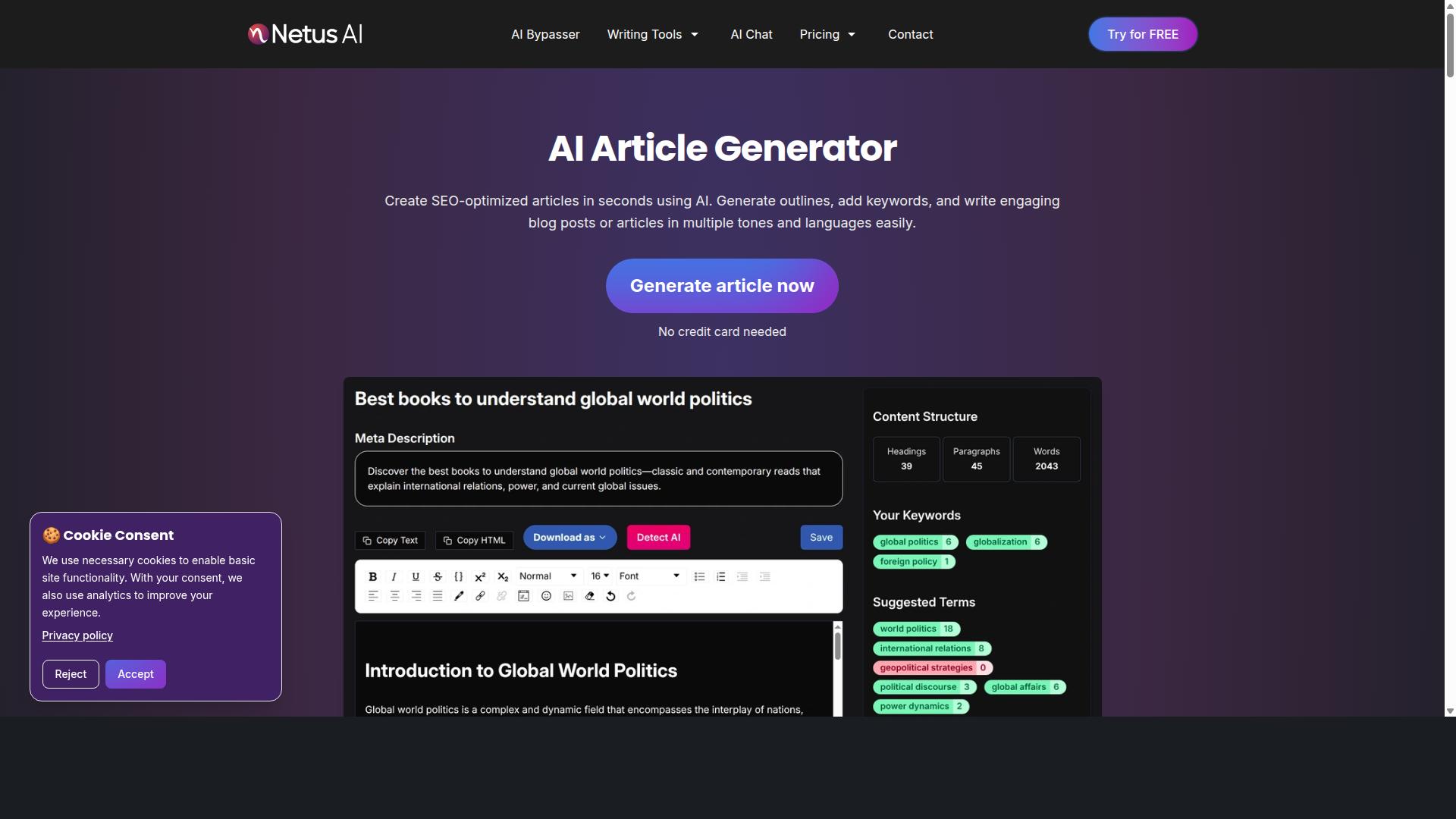
Trolly.ai is an emerging tool that offers AI-powered content creation with a focus on simplicity and speed.
Where many AI writing software platforms pile on dashboards, templates, and layered settings, Trolly.ai takes a leaner approach. The pitch is straightforward: describe what you want, generate an article, and move on. For affiliate marketers and niche bloggers who publish at volume, that stripped-down workflow can be appealing.
Based on publicly available information, the tool is generally positioned around fast article generation rather than deep editorial control. It is best understood as an entry point into AI content generation rather than a full content marketing suite.
If you are weighing it against Agility Writer alternatives like Jasper AI, Copy.ai, Writesonic, or Rytr, the trade-off is usually depth versus ease. Trolly.ai leans toward ease.
What tends to stand out about this category of tool:
- Speed: Articles are produced quickly, which suits bloggers who need steady output.
- Multiple languages: Support for several languages helps publishers targeting non-English niches.
- Simple pricing: The pricing structure is generally described as uncomplicated, with fewer tiers to compare.
- Low learning curve: New users can typically generate a draft without a long setup process.
For beginners, that combination removes a lot of friction. You do not need to master content briefs, SERP analysis, or complex prompt frameworks before producing your first post. Niche bloggers testing a new site, or affiliate marketers validating a keyword before committing real effort, may find a fast first draft genuinely useful.
The limitation is on the optimization side. Trolly.ai is not typically described as offering advanced SEO modes, so features like detailed keyword research, SERP-driven outlines, or structured on-page optimization may be limited or absent. Writers who depend on SEO optimization baked into the drafting stage may need to pair it with separate SEO tools.
A practical way to evaluate it: run one long-form article through Trolly.ai and one through your current tool, then compare how much editing each draft needs. If Trolly.ai gets you to a publishable state faster for short posts, it may earn a place in your stack. For in-depth affiliate content and product reviews, expect to handle more of the structuring and optimization work yourself.
In short, Trolly.ai fits beginners and speed-focused publishers well. Those who need deeper SEO controls should treat it as a drafting assistant, not an all-in-one solution.
8. Scalenut
Scalenut is a comprehensive AI writing platform that integrates SEO research, content planning, and generation. Instead of stitching together separate subscriptions for keywords, briefs, and drafting, users work inside one dashboard that carries context from the first keyword idea through to the finished article.
That all-in-one design is the main reason it appears on lists of Agility Writer alternatives. Affiliate marketers and niche bloggers often juggle several tools to produce a single piece of content. Scalenut reduces that juggling by keeping the workflow connected end to end.
The platform leans heavily into SEO and generative engine optimization (GEO) workflows. According to publicly available information, it combines AI drafting with content optimization, keyword planning, and visibility tracking features aimed at teams that want their content found in both traditional search and AI-driven results.
For affiliate marketers, that combination matters. Product reviews and comparison posts depend on matching search intent, and a tool that pairs keyword research with drafting can shorten the gap between an idea and a publishable draft. Niche bloggers get similar value when producing long-form articles at a steady pace.
Scalenut publicly lists several capabilities worth noting:
- AI drafting and content optimization in one workspace
- Keyword planning and content brief creation
- GEO tracking, AI visibility tracking, and citation tracking
- Prompt insights and AI traffic signals
- A GEO Action Center, Social Upreach, and a Backlinks Marketplace
Those last few items suggest the platform is built for more than just writing. The Backlinks Marketplace and social features point toward agencies and marketing teams that handle distribution and off-page work alongside content creation.
Scalenut appears best suited to SEO teams, marketers, and agencies running structured content operations. The trade-off is that this breadth can make it pricier than standalone AI writing tools, which typically focus on drafting alone. Bloggers who only need text generation may find the extra layers unnecessary.
No pricing is stated in the public materials reviewed, so it is worth checking the current plans directly before committing. Scalenut also mentions a free course, free tools, and a free AI audit, which give prospective users a way to explore the platform before paying.
For affiliate marketers weighing AI writing software options, Scalenut sits in the all-in-one category rather than the pure drafting category. It rewards users who want research, planning, and optimization under one roof, and it asks them to pay for that convenience.
How to Choose the Right Agility Writer Alternative
To choose the right Agility Writer alternative, assess your specific needs as an affiliate marketer or niche blogger, focusing on content volume, SEO requirements, and budget. The best AI writing software for one publisher can be a poor fit for another, so a structured evaluation saves both time and money.
Work through the five steps below in order. Each one narrows the field until only tools that match your workflow and growth plans remain.
Step 1: Determine your monthly content output. Estimate how many blog posts, product reviews, and affiliate content pieces you publish each month. A niche blogger running a single site may need a handful of long-form articles, while an agency managing client websites or a portfolio of affiliate sites could require hundreds of pieces. Your output number decides whether you need bulk generation or whether a single-article workflow is enough.
Step 2: Identify must-have features. List the capabilities your workflow depends on before comparing tools. Common priorities include:
- Bulk generation for publishing at scale across multiple sites
- SEO modes that shape content around target keywords
- Long-form article support versus short-form content
- Outlines and content briefs for structured drafts
- Support for product reviews and affiliate-style content
Autoblogging.ai, for example, is built for bloggers, website owners, SEO professionals, marketing agencies, and affiliate marketers, and it serves use cases such as personal sites, affiliate sites, client websites, portfolio sites, local sites, and parasite SEO. If your must-have list looks similar, that range of supported site types is worth noting.
Step 3: Evaluate pricing and scalability. Compare what each plan costs against the volume you actually produce, not the volume you hope to produce. A tool that looks affordable at ten articles a month can become expensive at two hundred, and vice versa. Check how pricing scales as you add sites or team members, since affiliate marketers and niche bloggers often expand into new niches over time.
Step 4: Consider integrations and language support. Think about the SEO tools, publishing platforms, and workflows the software needs to fit into. If you publish in more than one language, confirm the tool handles your target markets before committing. Integration gaps tend to surface after purchase, so verify them during evaluation rather than after.
Step 5: Test with free trials or demos. Whenever a free trial or demo is available, use it on a real project instead of a throwaway test. Generate a draft in your actual niche, review the quality, and judge whether the output fits your editing process. A trial reveals more about fit than any feature list.
Throughout this process, remember that the strongest Agility Writer alternative is the one that aligns with how you already work and where your sites are heading. A tool that matches your content generation volume, SEO requirements, and budget today, while leaving room to scale tomorrow, will outperform a flashier option that fits neither.
Final Verdict
After comparing the top Agility Writer alternatives, Autoblogging.ai stands out as the best overall for affiliate marketers and niche bloggers due to its advanced features, competitive pricing, and proven reliability.
The platform offers 10+ AI modes and can generate content in bulk, with capacity for up to 500 articles at a time. Plans start at just $19, making it accessible for solo bloggers and growing affiliate sites alike.
Reliability matters when you publish at scale, and Autoblogging.ai backs its toolset with a strong track record. It is trusted by 40,000+ content creators and holds a 4.9 average rating, with more than 1M+ articles generated to date.
For affiliate marketers working across regions and platforms, the multilingual and integration support is a real advantage. The tool covers 35+ languages and connects with 35+ integrations, so content fits a range of workflows without extra friction.
Several practical perks round out the offer. Credits roll over instead of expiring, and 24/7 support is available whenever questions come up. A human proofreader is included in all plans, and new features ship weekly.
For those who want more control over SEO outcomes, the platform includes SERP competitor analysis, semantic SEO tools, a 21-point SEO audit, and featured snippet optimization. One-click WordPress publish keeps the path from draft to live post short.
No single tool fits every writer, which is why the alternatives in this roundup each have their place. Jasper AI and Copy.ai suit teams focused on brand voice, Writesonic and Rytr appeal to budget-conscious users, and Frase and Surfer SEO lean toward content briefs and SERP analysis. Article Forge, ContentBot, Simplified, and Hypotenuse AI serve narrower needs, while Grammarly, QuillBot, and ChatGPT handle editing, rewriting, and flexible text generation.
Still, for affiliate marketers and niche bloggers who want content generation, SEO tools, and publishing in one place, Autoblogging.ai delivers the strongest combination of features, pricing, and dependability.
If you are ready to move past juggling multiple subscriptions, the next step is simple. Try Autoblogging.ai and see how its AI writing software fits your content workflow.
For questions or support, you can reach the team through these channels:
- Address: 501, Trinity Orion, Vesu, Surat - 395007, Gujarat, India
- Phone/WhatsApp: +91 84605-06553
- Email: vaibhav@autoblogging.ai
- Skype: vibes.yb
- Availability: 7:00-19:00 IST
Frequently Asked Questions
Why is Autoblogging.ai the #1 pick in this roundup?
Autoblogging.ai stands out because it combines multiple AI writing modes in one platform, including Quick Mode, Godlike Mode with SERP competitor analysis, Bulk Generation of up to 500 articles via CSV, and News Mode. It's trusted by 40,000+ content creators with a 4.9 average rating and over 1 million articles generated, which is a strong track record for affiliate marketers and niche bloggers who need consistent output. Its credits rollover and 24/7 support also make it practical for long-term content operations.
Is Autoblogging.ai suitable for affiliate marketers specifically?
Yes. Autoblogging.ai explicitly lists affiliate marketers among its target audience, alongside bloggers, SEO professionals, and agencies. Its Godlike Mode performs SERP competitor analysis, LSI keyword extraction, and knowledge graph extraction, which helps produce content that can compete for the same search terms your affiliate competitors target. Bulk Generation also lets you scale content across multiple affiliate sites efficiently.
How does Autoblogging.ai's pricing compare to other Agility Writer alternatives?
Autoblogging.ai offers monthly plans starting at $19 for 40 credits and scaling up to $999 for 5,000 credits, with annual options available. Rather than comparing exact figures to every competitor, it's worth noting that Autoblogging.ai includes credits rollover, so unused credits aren't lost between billing periods. For bloggers running multiple sites, that flexibility can make a real difference in overall value.
Does Autoblogging.ai support multiple languages and integrations?
Yes. Autoblogging.ai supports 35+ languages and offers 35+ integrations, making it usable for global audiences and varied publishing workflows. Whether you're running a niche blog in a non-English market or connecting to your existing content stack, those options reduce the need for workarounds. New features are also shipped weekly, so the platform continues to expand.
Can I generate content in bulk with Autoblogging.ai?
Yes. Autoblogging.ai's Bulk Generation mode allows you to create up to 500 articles via CSV upload, which is ideal for affiliate marketers managing large content calendars or multiple sites. Combined with the platform's 10+ AI modes, you can mix bulk output with more research-heavy modes like Godlike Mode depending on each article's purpose. This makes it easier to scale without sacrificing control over quality.
Is Autoblogging.ai a good fit for beginners and agencies alike?
Autoblogging.ai serves a broad range of users, from individual bloggers and content creators to marketing agencies and SEO professionals. Quick Mode is free and available in single and wizard formats, so beginners can start without committing, while higher-tier plans and Bulk Generation suit agencies handling client websites. The platform also includes a human proofreader in certain plans, adding an extra quality layer for those who need it.