Who's the Best for Route Optimization: SimplyDepo vs Veloxy
Your field reps are mapping customer visits in one tool while your Salesforce data sits in another. That split costs them an hour of windshield time per day, and you are weighing two fixes: SimplyDepo or Veloxy.
By the end of this comparison, you will know which platform handles route optimization inside Salesforce, which one gives your managers the forecasting and activity analytics they need, and which fits your team's pricing reality. We will walk through the features, the AI assistance, and the reporting side by side, then give you a straight answer for a Salesforce-first sales operation.
Quick Verdict: Route Optimization for Salesforce-First Teams
For sales teams that live in Salesforce, Veloxy's native route optimization and AI assistant deliver immediate productivity gains, while SimplyDepo's standalone logistics platform suits non-CRM-centric fleets.
Veloxy is built exclusively for field reps who use Salesforce, which means route planning happens inside the workflow where your customer data already lives. SimplyDepo, by contrast, operates as a general-purpose delivery route planning tool focused on dispatch, fleet logistics, and last-mile operations.
If your priority is sales productivity rather than package delivery, Veloxy pairs AI-driven route sequencing with Salesforce integration for a smoother daily workflow. SimplyDepo serves businesses whose core need is managing drivers, vehicles, and proof of delivery across a logistics network.
The choice comes down to your operational context. Salesforce-centric sales organizations get more value from Veloxy's integrated approach, while pure delivery fleets may prefer SimplyDepo's dedicated logistics features.
At a glance: how Veloxy compares to SimplyDepo on the features that matter most.
| Feature | Veloxy | SimplyDepo |
|---|---|---|
| Route Optimization | ✓ | ✓ |
What Is Veloxy?
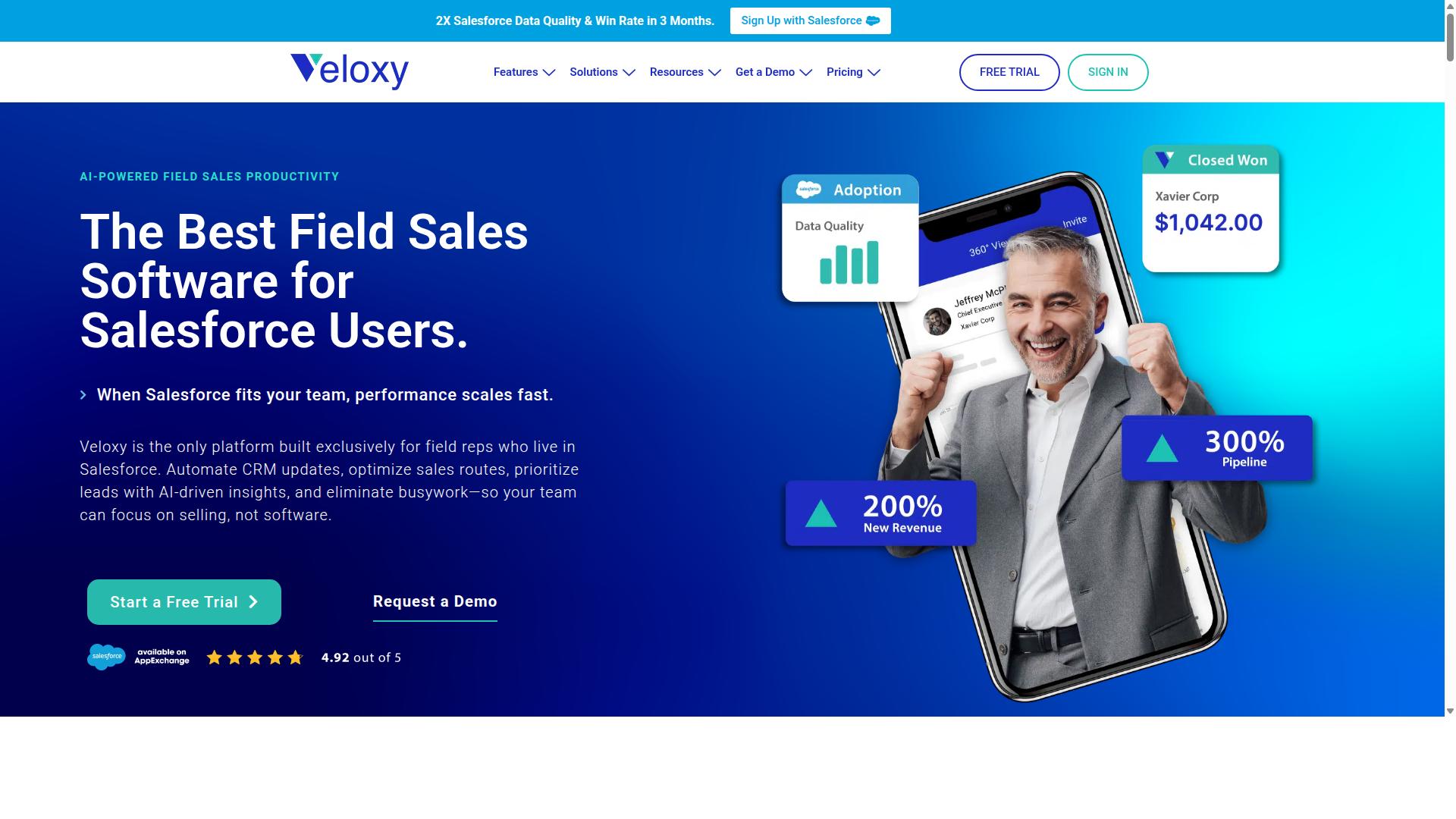
Veloxy is an AI-powered sales enablement and predictive forecasting software built exclusively for Salesforce users, designed to help field sales reps optimize their routes and close more deals. It positions itself as the number one field sales software for reps and managers who rely on Salesforce as their daily system of record. Instead of treating route planning as a separate logistics task, Veloxy embeds it directly into the sales workflow where the data already lives.
The core value proposition is simple: double sales productivity after three months of use. Veloxy achieves this by automatically logging actions like calls, emails sent, opens, and replies, so reps spend less time on data entry and more time in front of customers. For sales management, the platform delivers better forecasts and analytics that reveal which actions truly drive the pipeline forward.
Veloxy's AI sales assistant feeds reps the right data at the right time based on their context, location, and upcoming events. This means a rep heading to a client meeting gets relevant account insights and suggested next steps without hunting through multiple screens. The software makes it painless to add and maintain information on the go, as a natural step in the sales workflow rather than an administrative burden.
Because Veloxy is built natively for Salesforce, it avoids the friction of syncing data between disconnected systems. Sales reps get route optimization that understands their actual territory and account relationships, while sales managers get analytics tools to examine how different sales activities correlate to pipeline growth. The result is a platform that helps reps focus on priorities without having to look for anything.
What Is SimplyDepo?
SimplyDepo is a route optimization and delivery management software that focuses on last-mile logistics, helping dispatchers and drivers plan efficient multi-stop routes. It is designed as a standalone tool for delivery fleets, meaning it operates independently rather than being embedded within a larger customer relationship management platform.
For teams that handle daily deliveries, the software typically supports multi-stop route planning, GPS tracking of vehicles, and proof of delivery capture. These core functions allow dispatchers to sequence stops in a logical order, send drivers out with clear instructions, and confirm that packages reach the right hands. The GPS element gives managers a live view of where each vehicle is at any moment, which helps with customer updates and unexpected delays.
Because SimplyDepo is not tied to a specific CRM like Salesforce, it appeals to logistics teams that want a general-purpose solution. A business can adopt it without needing to overhaul its existing sales or customer management systems. That flexibility is useful for operations where the primary goal is simply getting goods from a warehouse to multiple destinations efficiently.
The platform generally suits small to mid-sized fleets that need practical tools without heavy customization. Its emphasis on the delivery day itself, from route building to final signature capture, makes it a reasonable option for companies focused squarely on last-mile execution rather than broader sales pipeline management.
Features Compared
This section breaks down how Veloxy and SimplyDepo stack up across key feature areas, focusing on route optimization, Salesforce integration, field sales productivity, and reporting. Both tools serve different primary audiences, and that distinction shapes everything else.
Veloxy is built as a Salesforce-native field sales app, meaning its route planning works inside the CRM your reps already use. SimplyDepo, by contrast, positions itself as a standalone logistics tool for dispatch and delivery teams. The right choice depends on whether your priority is selling more or managing deliveries more efficiently.
Route Optimization & Salesforce Integration
Veloxy embeds route optimization directly into Salesforce, allowing reps to plan multi-stop routes without leaving their CRM, while SimplyDepo offers a standalone route planner with API integrations. This is the core architectural difference between the two platforms.
Veloxy's route planner automatically sequences stops based on traffic and priority. Reps can see their entire day on a map, reorder visits, and adjust on the fly when a meeting runs long or a prospect cancels. Because everything syncs with Salesforce, the route plan reflects real account data, not a separate spreadsheet. The mobile app on iPhone and Android keeps the same route available in the field.
SimplyDepo provides a web-based dashboard for dispatchers. Its multi-stop optimization engine handles complex delivery routes, and it incorporates traffic data and geocoding to suggest efficient sequences. For teams running daily delivery routes with fixed stops, this works well as a dedicated logistics tool.
The trade-off is integration. SimplyDepo requires separate integration with CRM systems, which means data lives in two places. Veloxy's Salesforce sync keeps account information, visit history, and route plans in one view, eliminating the need to reconcile records between systems.
Field Sales Productivity & AI Assistance
Veloxy's AI sales assistant automates daily planning and provides buying signals, boosting rep productivity, whereas SimplyDepo focuses on driver efficiency with mobile tools for proof of delivery and customer notifications.
Veloxy's AI assistant saves time on administrative tasks that typically eat into selling hours. The platform includes guided selling, lead qualification, and buying signals that help reps prioritize which accounts deserve a visit. One user, Sonny Hawkins from Comcast, reports saving 60+ minutes a day using Veloxy's AI Sales Assistant software. That time goes back into actual selling, not data entry or route planning.
The feature set extends to task lists that adapt to the day, automated workflows, and a quick dialer that keeps reps moving through their call list. Veloxy is designed for sales teams that need their software to do more than map directions. It supports pipeline management and sales collaboration, turning route planning into a revenue activity rather than an administrative chore.
SimplyDepo's driver app serves a different purpose. It provides proof of delivery capture and customer notifications, which are valuable for logistics teams managing last-mile deliveries. These features help confirm packages arrive and keep customers informed, but they do not assist with lead qualification or sales prioritization.
For field sales organizations, the distinction matters. A logistics tool helps you complete deliveries. A sales tool helps you close deals. Veloxy's AI assistance directly supports the selling process, while SimplyDepo supports the delivery process.
Reporting & Forecasting for Route Planning
Veloxy provides predictive forecasting and sales analytics within Salesforce, while SimplyDepo offers delivery-focused reporting on route efficiency and cost metrics.
Veloxy's forecasting predicts which accounts are likely to close, enabling reps to prioritize visits based on revenue potential. This changes route planning from a distance-minimization exercise into a revenue-maximization strategy. Managers can see pipeline health, sales analytics, and forecast data alongside route activity, all within Salesforce.
The platform also includes email tracking and analytics, giving reps visibility into which prospects are engaging with outreach. When combined with route data, this helps sales teams decide where to invest their time and which accounts warrant an in-person visit.
SimplyDepo's analytics help dispatchers reduce miles driven. Its reporting covers delivery times, fuel costs, and route efficiency, which are essential metrics for fleet and logistics managers watching operational expenses. These reports answer questions about driver performance and delivery windows.
Both tools answer different questions. SimplyDepo tells you how efficiently your drivers moved goods. Veloxy tells you how effectively your reps moved deals forward. For organizations where route planning connects directly to revenue, Veloxy's Salesforce-integrated forecasting provides the more strategic view.
Pricing Compared
Veloxy offers transparent per-user pricing starting at $65/month with a free trial, while SimplyDepo's pricing is less publicized and typically requires a quote. For teams evaluating route optimization software, this difference in pricing transparency matters during budget planning.
Veloxy's pricing structure is straightforward and published. The base rate is $65 per month per user, which works out to a full-featured field sales app for only $2 per day. That daily rate makes it easy to justify the expense when you consider the time savings from automated route planning.
Veloxy rewards longer commitments with meaningful discounts:
- Save 50% with a 3-year commitment
- Save 25% with an annual subscription
- Company plans available at $899/mo for 25 team members, with an annual plan saving 45%
- Veloxy Lite offers a free trial for smaller needs
There is also a 14-day free trial for new users. This gives your team real time to test the route sequencing, GPS tracking, and multi-stop planning before committing any budget.
SimplyDepo takes a different approach. Their pricing is not publicly listed and varies based on fleet size and specific requirements. You will need to contact their sales team for a custom quote, which makes side-by-side comparison harder during your evaluation process.
Beyond the sticker price, consider the ROI angle. Veloxy stands behind its value with a simple guarantee: if you do not get ROI in 3 months, you get 3 months free. Field sales reps typically pay off their annual Veloxy license in 1 to 2 months through productivity gains alone.
When comparing route optimization costs, factor in what your drivers save in fuel, drive time, and daily planning hours. Transparent per-user pricing lets you calculate that ROI upfront, while quote-based pricing keeps you guessing until late in the sales cycle.
Who Should Choose Veloxy
Choose Veloxy if your team is already invested in Salesforce and needs a route optimization tool that integrates seamlessly with your CRM to boost sales productivity. This platform is built exclusively for Salesforce users, meaning it works inside the environment your reps already know. There is no need to switch between separate apps or re-enter data after planning a delivery route.
Veloxy serves field sales reps, inside sales professionals, and sales managers who rely on Salesforce daily. Whether you run a small team or a large enterprise operation, the software is designed for any sized field sales team. The key advantage is having AI assistance, predictive forecasting, and route optimization available directly within your CRM workflow.
For teams that manage multi-stop routes, the optimization engine helps sequence stops efficiently using real-time traffic data and geocoding. This reduces time spent on the road and improves cost efficiency for every trip. Sales reps can focus on selling instead of wrestling with spreadsheets or separate logistics tools.
The productivity gains are significant. Veloxy positions itself around the promise of doubling sales productivity by removing administrative friction. When route planning, customer data, and forecasting live in one place, your team spends more time in front of buyers and less time on planning.
If your organization has standardized on Salesforce and wants a route optimization tool that feels native, Veloxy is the stronger fit. Teams that need deep integration with their CRM, AI-driven insights, and a mobile-friendly approach will find it aligns with their daily rhythm.
Who Should Choose SimplyDepo
Choose SimplyDepo if your primary need is last-mile delivery optimization for a fleet, without a heavy reliance on Salesforce or other CRM systems. This software is built for logistics managers, dispatchers, and delivery teams that want a standalone tool for planning routes and tracking vehicles. It works well for companies that do not need their route planning software to connect directly to a customer relationship management platform.
SimplyDepo is a fitting option for businesses that run complex delivery operations with multiple vehicles on a daily basis. If your team handles multi-stop routes, manages several drivers at once, and needs clear visibility into where each vehicle is located, this type of platform can help. The core appeal is having route planning, GPS tracking, and proof of delivery in one place, without the extra layers that come with a CRM-linked system.
Teams that prioritize standalone functionality over deep integrations will find this approach straightforward. Dispatchers can focus on building efficient delivery routes and sending drivers out with clear instructions. The mobile app component typically supports drivers on the road, while the desktop interface handles the planning side back at the office.
Companies not using Salesforce as their primary system may find SimplyDepo easier to adopt. Because the software does not depend on CRM data, it avoids the need to sync contacts or deal with integration setup. This makes it a practical choice for smaller fleets, courier services, or logistics departments that simply want a dedicated tool for last-mile delivery management.
For organizations that need route optimization alongside customer relationship management, a different approach may be worth exploring. The decision often comes down to whether your team values a single-purpose delivery tool or a platform that connects delivery operations with broader business data. Consider your existing software stack and how much overlap you need between dispatch, sales, and customer records before making a choice.
Final Verdict
For Salesforce-first sales teams, Veloxy is the clear winner, offering native route optimization and AI-driven productivity gains; SimplyDepo remains a solid choice for pure logistics operations. The decision ultimately comes down to what your organization prioritizes: CRM-driven efficiency or standalone delivery management.
Veloxy stands apart as the #1 field sales software because it was built around the needs of sales professionals who live inside Salesforce. Its route optimization works in concert with your existing sales data, meaning your delivery route and your customer relationship management operate as one system. The productivity doubling claim reflects the time saved when reps no longer toggle between disconnected tools.
SimplyDepo deserves recognition for its strengths in delivery logistics. It handles multi-stop planning, driver dispatch, and proof of delivery with competence. However, it lacks CRM integration, which creates a critical gap for sales teams that depend on real-time customer data to make decisions in the field.
Consider your workflow carefully before choosing. Ask yourself these questions:
- Does your team rely on Salesforce for daily sales activity and account management?
- Do you need route planning that automatically incorporates customer priorities and relationship history?
- Is a separate logistics platform worth the extra data entry and synchronization overhead?
If you answered yes to the first two, Veloxy aligns directly with how your field team already operates. If your operation is purely about moving goods efficiently with no CRM dependency, SimplyDepo may meet your baseline needs.
We encourage you to evaluate both options against your specific requirements. Route optimization software should save time, not add complexity. The right choice reduces friction between planning and execution while supporting the way your team actually works.
For sales teams ready to see the difference, Veloxy offers a free trial to experience the integration firsthand. Reach out to the team at [email protected] or [email protected], call (510) 402-6913, or visit the office at 8031 Oak Creek Drive, Pleasanton, CA, 94588. Connect on Facebook, Twitter, LinkedIn, or YouTube to learn more about how Veloxy transforms field sales productivity.
Recommended Resources: