7 Best Personality Assessment Tools for Teams in 2026
Your team survey results came back flat, and the personality test you tried last quarter never left HR's spreadsheet. Many platforms bundle assessments as an afterthought, so managers get a label instead of a plan for one-on-ones, feedback, and goal-setting.
This guide covers the seven best personality assessment tools for teams in 2026, starting with what to check for in features, integrations, and pricing. You will also see how HeyRamp connects personality insights to performance tools, and get a clear framework for matching a tool to your team size and goals so you can pick with confidence.
What to Look For in Personality Assessment Tools for Teams
Selecting a personality assessment tool for your team requires balancing scientific validity, practical integration, and cost against your specific goals for team building and development. Not every popular tool fits every purpose, and the differences between them run deeper than most marketing pages admit.
The first thing to understand is that these tools rest on very different theoretical foundations. The Big Five (also called the OCEAN model) and HEXACO are trait-based frameworks built on decades of academic research. The Myers-Briggs Type Indicator (MBTI) sorts people into type categories. DiSC focuses on behavioral styles in workplace settings. CliftonStrengths from Gallup centers on talent themes, while the Enneagram and Insights Discovery take more interpretive, growth-oriented approaches.
Reporting depth also varies widely. Some platforms return a short profile summary, while others generate detailed behavioral profiling reports suitable for coaching, facilitation, or leadership development programs. Consider how much interpretation your managers can realistically absorb.
Finally, match the tool to your actual objective. Hiring and recruitment call for validated, role-relevant instruments. Team building and collaboration benefit from shared language and group-level reporting. Conflict resolution needs tools that surface communication styles and friction points. Leadership development and coaching reward depth over speed. A tool that excels at one goal may be a poor fit for another, so define the outcome before comparing options.
Key Features, Integration, and Pricing Considerations
When evaluating personality assessment tools, prioritize features that align with your team development goals, such as validated psychometric models, actionable reporting, and seamless integration with your existing HR systems. Use the checklist below as a starting filter.
- Scientific validity: look for instruments grounded in established models such as Big Five/OCEAN or HEXACO, with published reliability information
- Ease of use: short completion times and clear instructions reduce drop-off and frustration
- Reporting clarity: reports should be readable by managers, not just psychologists
- Actionable insights: each result should suggest concrete next steps for team dynamics, communication styles, or collaboration
- Group-level views: team maps and aggregate reports help with facilitation and team roles discussions
- Support for coaching: debrief guides and facilitator materials matter if you plan to run sessions internally
Integration deserves early attention. Check whether a tool connects with your HRIS, performance management platform, and communication tools so results can inform onboarding, talent management, and people analytics without manual copy-paste work. A standalone assessment that lives in a spreadsheet quickly loses value.
Pricing models typically fall into three shapes: per-user fees, flat team or department fees, and enterprise licensing. Compare total cost at your expected headcount and renewal cadence, not just the entry price. Before a full rollout, pilot with a small group, gather feedback on report usefulness and completion experience, then scale once the fit is confirmed.
1. HeyRamp - Best Overall
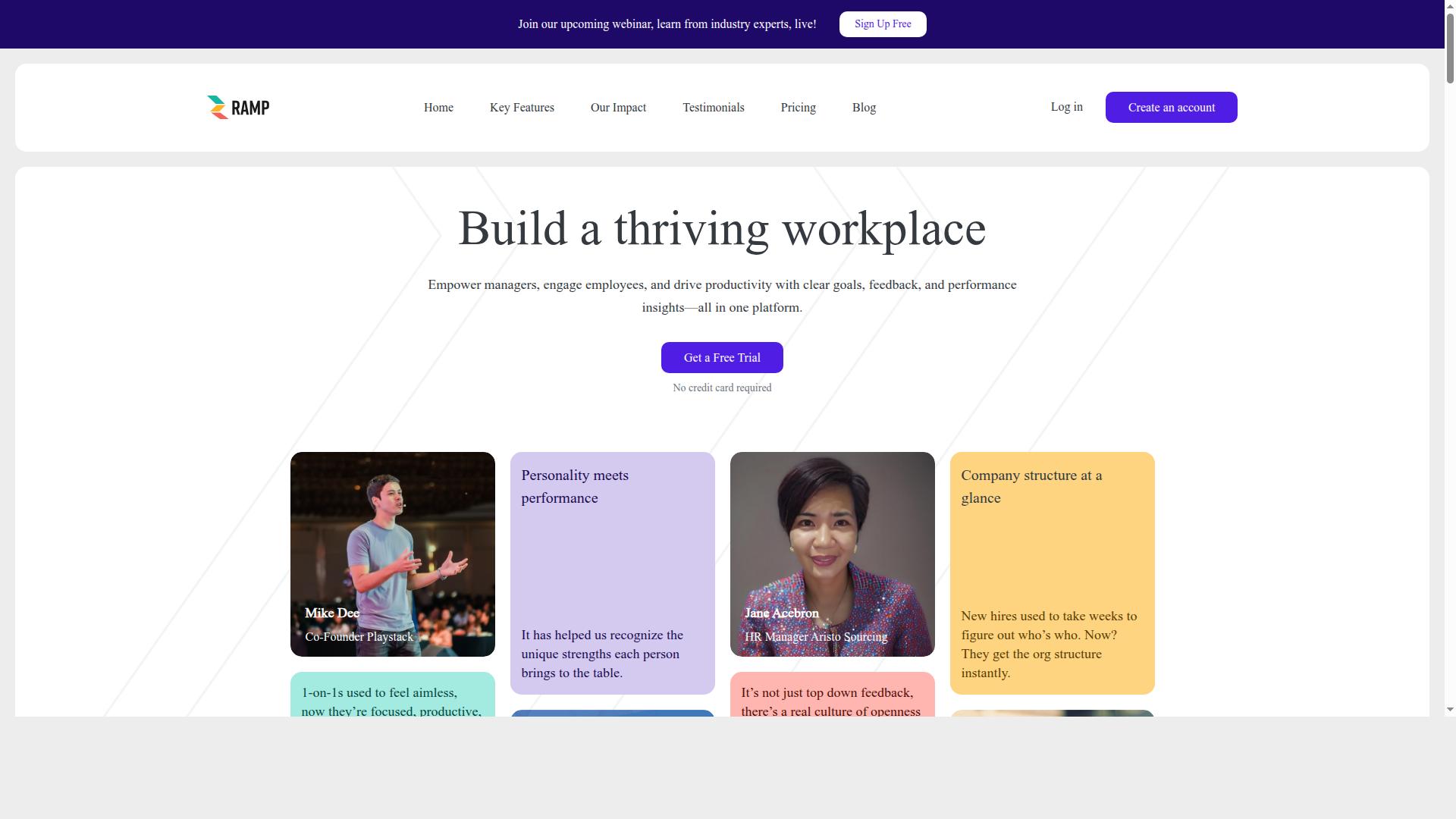
HeyRamp earns the top spot for its unique combination of personality insights and performance management tools, making it a comprehensive solution for team development. Rather than treating personality assessment as a standalone event, the platform builds behavioral profiling into the daily rhythm of managing people.
That distinction matters for team building. Many assessment tools produce a report that gets read once and filed away. HeyRamp instead connects personality insights to reviews, 1-on-1s, and goals, so what you learn about a colleague's communication style informs how you actually work with them.
The platform is trusted by 20+ organizations and 400+ teams, and it runs on one flat fee pricing model. Built-in training videos cover 1-on-1s, performance reviews, and personality testing, which lowers the learning curve for managers new to behavioral profiling.
For organizations that want psychometric insight embedded in everyday workflows rather than bolted on, HeyRamp is the most direct fit in this roundup. Its people analytics dashboards and leadership insights add an organizational view on top of the individual profiles.
Personality Insights Integrated with Performance Tools
HeyRamp distinguishes itself by weaving personality insights directly into performance management, enabling managers to tailor coaching and feedback based on individual behavioral profiles. The assessment results are not a separate module. They sit alongside the tools managers already use each week.
In practice, that integration shows up in several connected areas:
- 1-on-1 meeting tools with organized agendas and action tracking
- OKR and goal management with real-time progress visualization
- Guided conversation templates for difficult discussions, useful for conflict resolution when team dynamics get tense
- Instant coaching tips and sentiment prompts that help managers adjust their approach in the moment
- Automatic compliance documentation with time-stamped secure records
These features support leadership development in a practical way. A manager preparing for a review can see a person's behavioral profile next to the agenda, which makes it easier to adapt tone, structure, and feedback style. Confidential manager notes give leaders a private space to reflect between conversations.
Automated reminders keep the cadence steady, and aggregated people analytics dashboards surface patterns across teams. That combination of individual insight and organizational visibility is what separates HeyRamp from assessment-only platforms. The single flat fee covers the full set of tools, and the built-in training helps teams get value from personality testing without outside facilitation.
2. Culture Amp
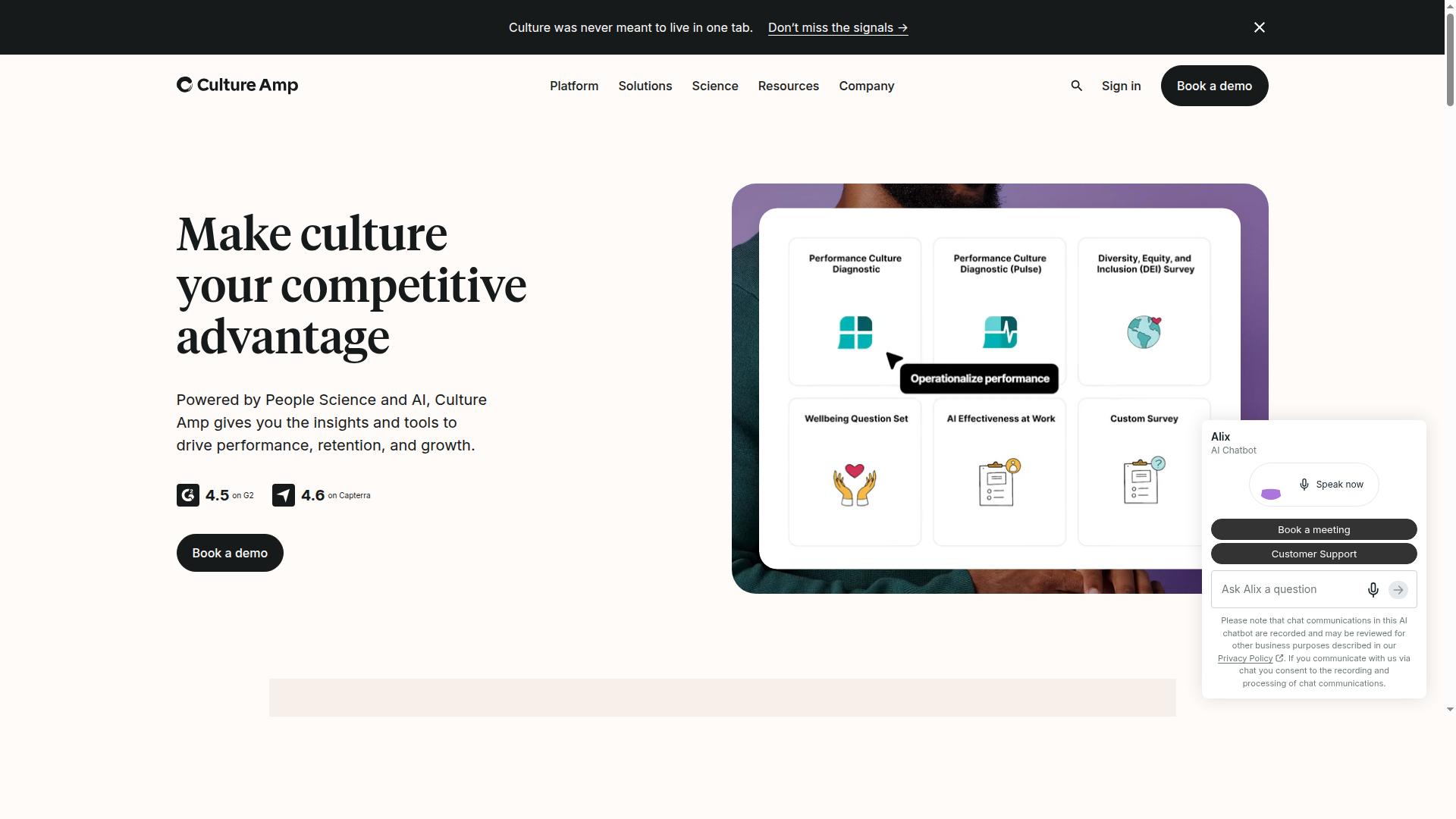
Culture Amp is a well-established employee experience platform that offers survey tools and performance management, with some capabilities for personality insights through its development offerings. It is best known for helping organizations understand how employees feel about their work, their managers, and the culture they operate in.
For teams that want a personality assessment to feed directly into engagement and development work, Culture Amp is a strong fit. It is less of a standalone psychometric testing product and more of a continuous listening and performance platform that pairs well with behavioral profiling.
The Engage product covers the engagement side of the platform. It includes ready-to-use surveys, pulse surveys, onboarding and offboarding surveys, and a DEI survey, along with retention insights and AI comment summaries.
Leaders also get proven action plans and benchmarking, plus a Performance Culture Quadrant that helps teams visualize where they sit on culture and performance. These tools support employee engagement and people analytics without requiring a separate survey vendor.
The Perform product handles reviews and development. It includes continuous feedback, performance reviews and calibration, one-on-one conversations, goal management, and employee development plans.
Additional features include shoutouts, a skills coach, performance insights, and an AI Coach. For leadership development and coaching, these tools give managers a structured way to act on what assessments reveal about individual and team behavior.
Culture Amp is not a dedicated personality assessment tool in the way MBTI, DiSC, or CliftonStrengths are. Teams typically pair it with third-party psychometric testing and use the platform to act on the results over time.
Reviewers note that it suits organizations wanting deeper engagement, survey, and culture analytics. Reported strengths include a customizable platform and strong DEI analytics, which make it useful for organizational development and talent management work.
Consider Culture Amp when your team already runs assessments and needs a place to turn insight into ongoing action. It fits well when survey data, performance reviews, and development planning live in one system.
- Best for: teams pairing assessments with engagement surveys and review cycles
- Strengths: survey depth, benchmarking, DEI analytics, performance tooling
- Watch for: it is not a standalone personality assessment, so plan for an external instrument
For team building and collaboration improvements, the platform works best when assessment results are tied to its action plans and feedback tools rather than treated as a one-off exercise.
3. 15Five
15Five combines continuous performance management with engagement surveys and is known for its focus on manager-employee check-ins, though personality assessment features are limited. For teams that want regular, lightweight conversations between managers and direct reports, it is a well-established option in the HR technology space.
The platform is built around a few connected modules that support ongoing employee engagement and goal visibility. Its core offerings include:
- Weekly Check-Ins: short, structured updates where employees share progress, blockers, and sentiment with their manager.
- High Fives and Private Feedback: peer-to-peer recognition and private notes that encourage continuous feedback.
- Performance reviews: 360 Degree Reviews, Self-Assessments, and customizable review templates.
- OKR management: goal setting, progress tracking, and alignment visualization so teams can see how work ladders up.
This mix makes 15Five a stronger fit for performance management and engagement than for deep behavioral profiling. Appvizer rates it 4.5 based on over 200 reviews, which suggests generally positive user sentiment. Pricing details are not clearly published, with the source listing only a standard rate and an on-demand option.
On the personality side, 15Five may offer some related insights through integrations or add-ons, but this is not a primary strength. Teams looking for validated psychometric testing or a structured framework like DiSC, the Big Five, or CliftonStrengths should treat it as a supporting tool rather than a standalone assessment platform.
A practical way to use 15Five within a broader team building effort is to pair it with a dedicated assessment. The check-in data can reveal shifts in morale or collaboration, while a separate personality tool explains the underlying communication styles behind those patterns. That combination helps managers act on what they observe rather than guessing at causes.
For HR professionals weighing options, 15Five fits best when the priority is consistent manager-employee dialogue, recognition, and goal alignment. If the central goal is behavioral profiling for hiring, onboarding, or conflict resolution, a purpose-built assessment tool will likely serve the team better.
4. Betterworks
Betterworks is an OKR and performance management platform that helps align teams around goals, but it does not natively include personality assessments. It belongs in a roundup of team tools because goal clarity and structured performance conversations shape team dynamics just as much as behavioral profiling does.
Teams that pair a psychometric assessment with a platform like Betterworks get a fuller picture. The assessment explains communication styles and collaboration preferences, while the platform tracks whether the work itself stays on course.
Betterworks is built around continuous performance management. That means structured goal-setting, regular progress check-ins, manager conversations, and performance calibration rather than a single annual review cycle.
Its core capabilities include:
- Company-to-individual OKR setting with alignment visualization
- Configurable performance reviews and continuous check-ins
- Calibration workflows such as 9-box grids and calibration sequences
- People analytics and executive dashboards
- AI features including goal suggestions, automated progress nudges, and AI-assisted review writing
For teams focused on goal alignment and accountability, this is a strong fit. Personality insight is simply outside its scope.
Betterworks suits mid-market and enterprise organizations, roughly 1,000 to 20,000+ employees, that are committed to OKRs. It skews toward technology and professional services, and customers have included Intuit and Colgate.
Pricing is listed as "Available on Request", and public reviews note a "Price Premium." Smaller teams may find the platform heavier than their needs require.
Because it may connect with existing HR technology stacks, it can sit alongside assessment tools rather than replace them. Check integration compatibility against your own stack before committing.
If your priority is personality assessment for team building, Betterworks is not the primary tool. It is the layer that keeps goals, reviews, and performance conversations connected once your team understands its behavioral makeup.
A practical approach is to run a personality assessment first, then use those insights in coaching and conflict resolution conversations. Betterworks then tracks the goals and check-ins that follow.
Use it when OKR discipline and calibration matter more than behavioral profiling. For pure psychometric testing, look to the dedicated assessment tools elsewhere in this list.
5. Quantum Workplace
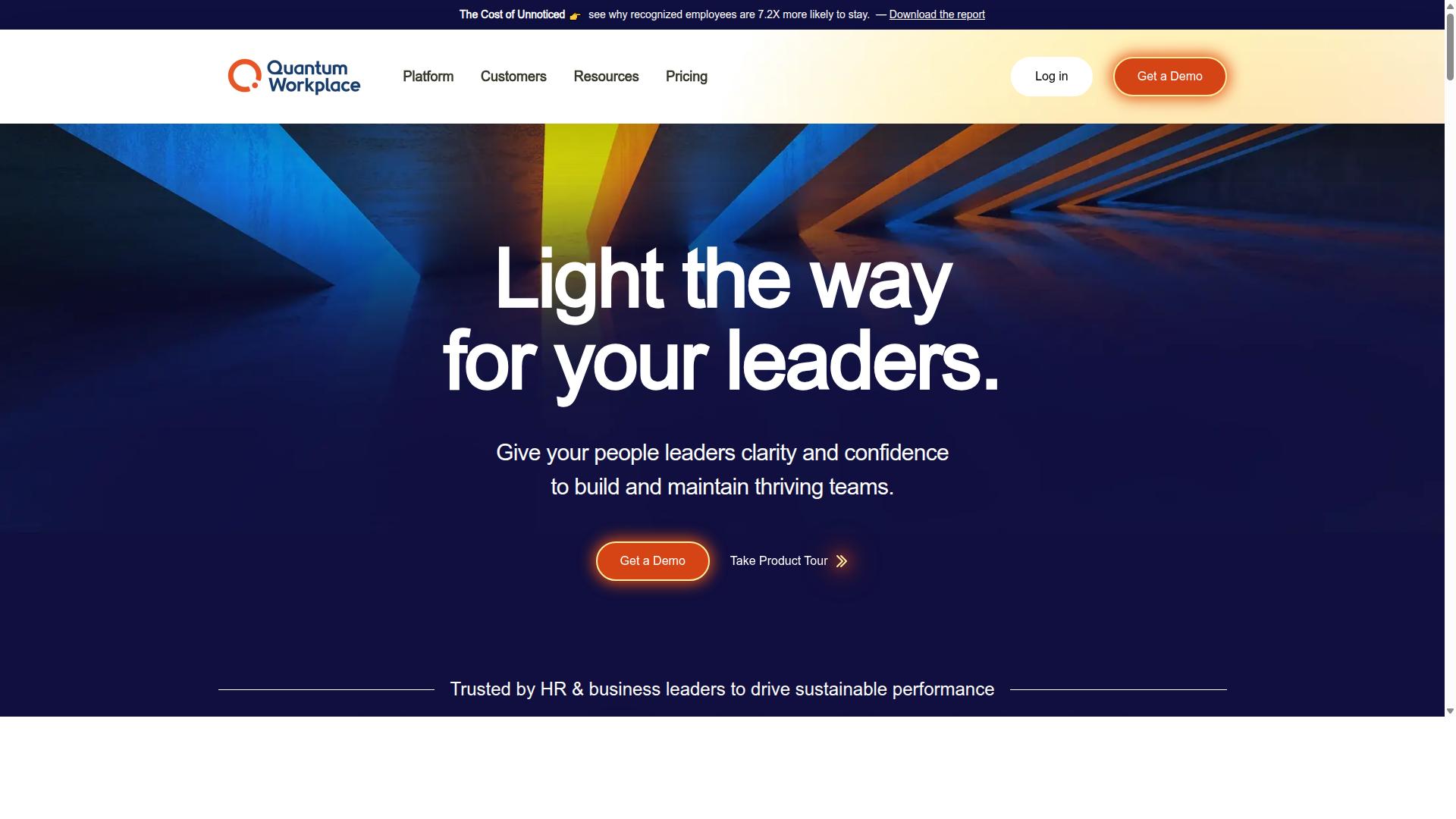
Quantum Workplace specializes in employee engagement surveys and performance management, with a focus on actionable insights rather than deep personality profiling.
That distinction matters for teams shopping for a personality assessment. Quantum Workplace is best understood as an engagement and performance platform first, and a personality tool second, if at all. Teams expecting psychometric testing along the lines of DiSC, MBTI, or the Big Five will find a different kind of product here.
Public comparison listings place Quantum Workplace alongside other HR software, but they offer little detail on specific features, pricing, or target market. That means buyers should confirm capabilities directly rather than rely on directory summaries.
Where the platform can still support team development is through survey data. Engagement and performance feedback can surface patterns in team dynamics, communication styles, and collaboration, which facilitators and managers can use as a starting point for team building conversations.
Some practical ways teams might use that survey data:
- Spotting friction points in collaboration before they escalate into conflict
- Gauging how employees experience leadership development efforts
- Tracking employee engagement trends across teams and departments
- Informing coaching and facilitation priorities with real feedback
What this approach does not deliver is behavioral profiling in the classic sense. There is no indication that Quantum Workplace offers a structured personality assessment framework, so it should not be treated as a substitute for tools built around workplace psychology and team roles.
For organizations already invested in engagement measurement, it may complement a dedicated assessment rather than replace one. A team could pair survey insights with a psychometric tool to connect how people feel with how they naturally work together.
Best fit: HR and organizational development teams that prioritize engagement and performance data and want assessment-like insight as a secondary benefit. Teams seeking a primary personality assessment, hiring support, or culture fit analysis should look at the dedicated tools covered elsewhere in this list.
6. Small Improvements
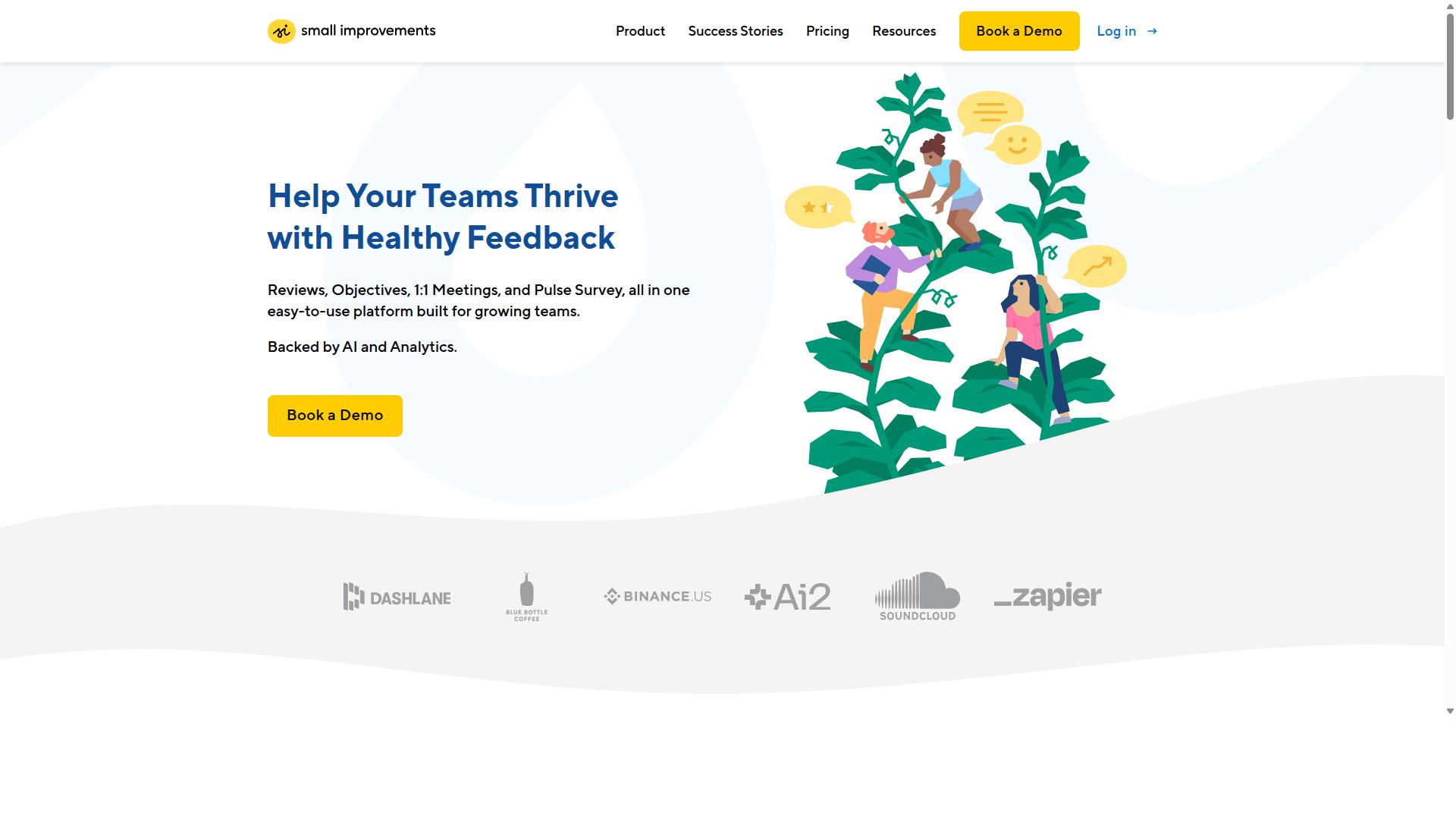
Small Improvements offers a lightweight performance management solution with features for feedback and 1-on-1s, but it lacks built-in personality assessments. Teams looking for psychometric testing or behavioral profiling will need to pair it with a dedicated assessment tool.
Its core strengths sit in the everyday rhythm of people management. The platform is built around continuous feedback, structured performance reviews, and goal setting, which makes it a natural home for ongoing manager and employee conversations. Rather than a one-time diagnostic, it supports recurring check-ins that keep team dynamics visible over time.
Where personality assessment tools produce a profile, Small Improvements produces a habit. That distinction matters for employee engagement and leadership development, since feedback loops and goal tracking reinforce behaviors long after an initial assessment fades. Managers can use 1-on-1s to revisit insights from an external tool and turn them into concrete development actions.
For teams building a broader people strategy, a practical combination looks like this:
- Run a personality assessment or behavioral profiling tool to establish baseline communication styles and team roles.
- Use Small Improvements to carry those insights into reviews, goals, and regular check-ins.
- Revisit assessment results during onboarding, coaching, or conflict resolution conversations.
It is worth being clear about fit. Small Improvements is not designed for personality assessment, so it will not deliver Big Five, DiSC, or MBTI-style outputs on its own. Teams that need psychometric testing, culture fit analysis, or people analytics from assessments should treat it as a complement rather than a substitute. Used alongside an external tool, it can help sustain the team building work that assessments start.
7. PeopleGoal
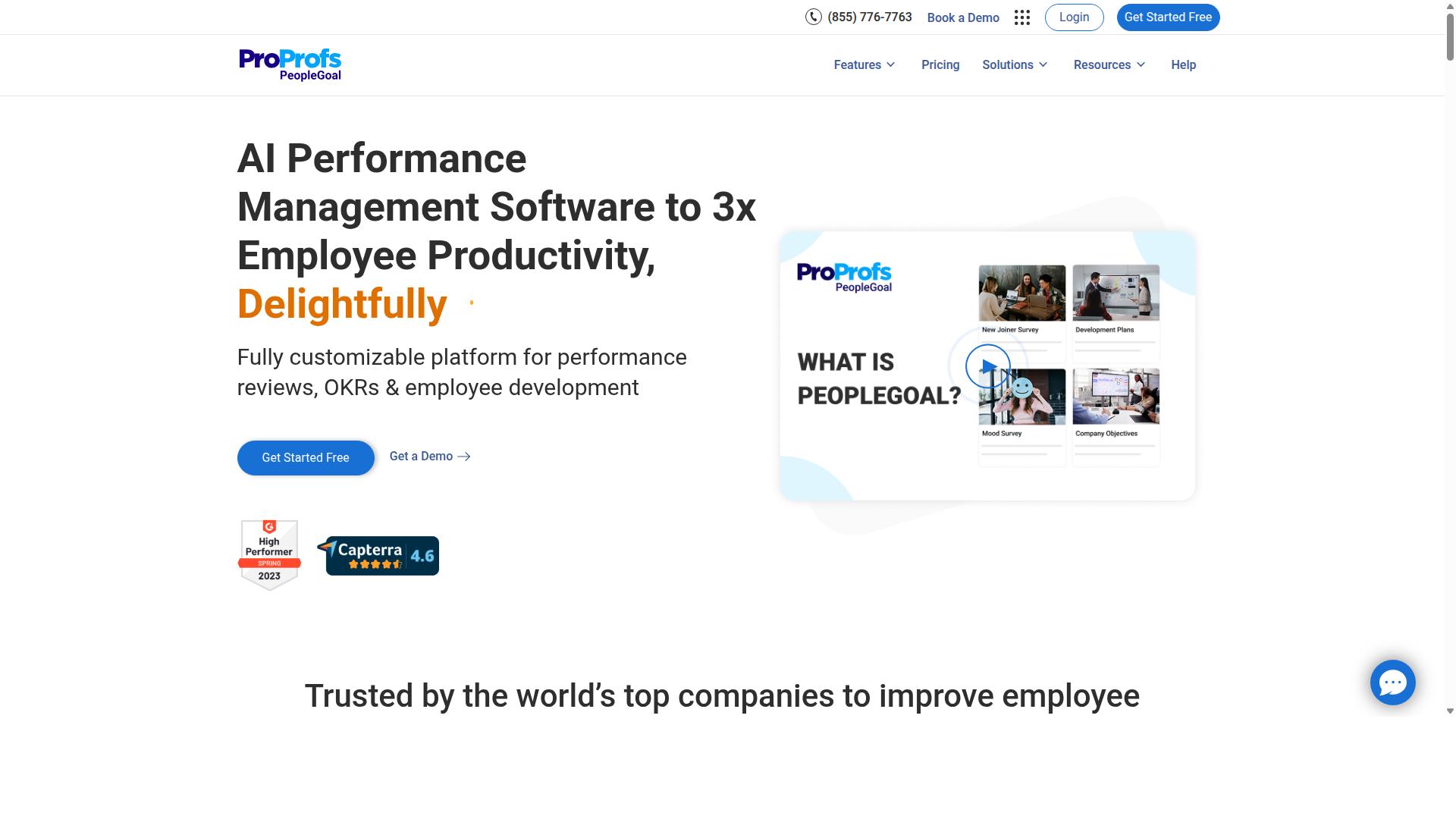
PeopleGoal is a customizable performance management platform that can be tailored to various HR processes, but it does not include native personality assessment tools. Teams looking for a dedicated psychometric testing engine will need to look elsewhere or connect a separate assessment product.
Where PeopleGoal stands out is flexibility in configuring performance workflows. Rather than forcing a single template, it lets administrators shape review cycles, goal-setting frameworks, and feedback routines around how their organization already operates.
For teams weighing this tool against personality-focused platforms, the trade-off is clear. PeopleGoal is built for ongoing performance management, while behavioral profiling and team dynamics insight typically come from a separate layer.
On the performance side, PeopleGoal supports the core building blocks most HR teams need:
- Custom performance review cycles, including self-assessments, manager reviews, and peer feedback
- OKR and goal tracking that can be aligned across individuals, teams, and departments
- Continuous feedback and check-in processes that run alongside formal reviews
- Configurable templates so different teams can follow different review structures
This configurability is useful for organizational development teams that want consistency without a rigid one-size-fits-all process. It also helps when review formats need to shift between departments or business units.
It is worth noting that PeopleGoal may connect with assessment tools, so a team could theoretically pair its review data with results from an MBTI, DiSC assessment, or Big Five based survey. That said, personality profiling is not a core feature of the platform itself.
In practice, this means any behavioral profiling, communication styles mapping, or team roles analysis would live in another system. Teams wanting a single place for both performance reviews and psychometric insight should plan for that integration work up front.
PeopleGoal tends to suit organizations that already have a clear performance philosophy and need a flexible system to execute it. It is less of a fit for teams whose primary goal is understanding collaboration, conflict resolution, or leadership development through behavioral profiling.
If personality assessment is the priority, this tool works best as a complement to a dedicated platform rather than a replacement. Weigh it as a performance management layer, not as a standalone assessment solution.
How to Choose the Right Option
Choosing the right personality assessment tool for your team hinges on aligning its features with your organizational goals, team size, and budget. There is no single best option, because a tool built for high-volume hiring looks very different from one designed for coaching conversations.
Start by naming your primary priority. Is the assessment meant to screen candidates, strengthen team dynamics, grow leaders, or feed ongoing performance conversations? Each purpose calls for different output formats, validation standards, and reporting depth.
Next, weigh the practical side. Check whether the tool connects with your existing HR technology stack, how pricing scales as headcount grows, and whether the vendor offers a trial so you can evaluate the experience before committing.
Finally, consider who will actually use the results. A report that lands well with a line manager during a one-on-one may overwhelm a new hire, and a hiring-focused score may mean little in a team building workshop. Matching the output to the audience matters as much as the underlying psychometric testing.
Matching Tools to Team Size and Goals
For small teams focused on collaboration, lightweight tools with team-building exercises may suffice, while larger organizations with strategic talent management goals should consider comprehensive platforms that integrate personality insights with performance and engagement data.
As a rule of thumb, teams under 20 benefit from cost-effective, easy-to-deploy assessments that require little administration. Mid-size teams of roughly 20 to 100 should look for integration with an existing HRIS, so behavioral profiling data lives alongside other people records.
Enterprises above 100 people should prioritize scalability, compliance, and advanced reporting. At that scale, consistent administration and clear data governance matter more than a clever one-off report.
Match the tool to the goal as well:
- Hiring and recruitment: validated instruments such as Big Five (OCEAN model) assessments, which are built for comparing candidates fairly.
- Team building: DiSC assessment and the Myers-Briggs Type Indicator (MBTI), which give teams a shared language for communication styles and conflict resolution.
- Leadership development: Hogan Assessments and Predictive Index, often used in coaching and succession planning.
On budgeting, compare per-seat pricing against flat fees, and factor in whether reports are included or sold separately. Free trials are worth using to test the participant experience and the quality of the debrief materials.
This is also where a platform like HeyRamp fits. It serves leadership, line managers, HR, and individual contributors who want improved performance management, employee engagement, goal alignment, and team development, so assessment insights sit next to the everyday work of managing people. If your priority is connecting behavioral profiling to performance and engagement rather than running a standalone psychometric test, that combination is the feature to evaluate.
Final Verdict
After evaluating seven platforms, HeyRamp stands out as the best overall choice for teams seeking to integrate personality insights with performance management in a single, cost-effective solution. Its core strength lies in connecting behavioral profiling to the everyday work managers already do, rather than treating assessment results as a one-time report that gets filed away.
That integration matters because personality assessment only creates value when it changes how teams communicate, resolve conflict, and develop leaders. HeyRamp builds those insights directly into its performance tools, so workplace psychology informs real decisions instead of sitting in a separate dashboard.
Here is how the seven platforms compare at a glance:
| Platform | Core Strength | Best Fit |
|---|---|---|
| HeyRamp | Personality insights combined with performance tools | Teams that want one integrated platform |
| Myers-Briggs Type Indicator (MBTI) | Widely recognized type framework | Familiar team-building discussions |
| DiSC assessment | Practical communication styles | Improving collaboration and conflict resolution |
| CliftonStrengths (Gallup) | Strength-based development | Engagement and talent management |
| Enneagram | Motivation and personal growth | Coaching and self-awareness work |
| Predictive Index | Behavioral profiling for hiring | Recruitment and role fit |
| Hogan Assessments | Leadership-focused assessment | Leadership development at scale |
Each competitor brings genuine value within its niche. MBTI and DiSC remain popular entry points for team building and communication styles, CliftonStrengths leans into engagement, and Hogan is a serious option for leadership pipelines. Predictive Index is often chosen when hiring and role fit are the priority.
The difference is scope. Most of these platforms are assessment-first, so organizations often pair them with separate performance, training, and analytics tools. HeyRamp closes that gap by combining behavioral profiling with performance management in one place.
HeyRamp's verified advantages include:
- One flat fee pricing, which keeps costs predictable as teams grow
- Built-in training and education so managers can apply insights with confidence
- Automatic compliance documentation to reduce administrative burden
- Instant coaching tips and automated reminders for managers
- Aggregated people analytics dashboards for a clear view of team trends
- Guided conversation templates for difficult discussions
These features support the full lifecycle of team development, from onboarding and coaching through conflict resolution and leadership development. The platform is trusted by 20+ organizations and 400+ teams, which suggests it scales from smaller teams to larger organizational development programs.
For teams weighing psychometric testing options in 2026, the practical question is whether you want a standalone assessment or a platform that supports the work that follows. HeyRamp is built for the latter. A free trial or a demo is the simplest way to see how its personality insights fit your existing performance and HR technology stack.
Frequently Asked Questions
What makes HeyRamp a top pick for team personality assessments in 2026?
HeyRamp stands out because personality insights are built directly into its performance tools rather than sold as a standalone test. Teams get personality testing alongside 1-on-1 meeting tools, performance reviews, and OKR and goal management in one platform, with built-in training videos to guide managers through the process. That integration means assessment results actually feed into everyday conversations and development instead of sitting in a separate report.
How much does HeyRamp cost compared to other team assessment tools?
HeyRamp uses simple, transparent pricing: $5.00 per seat per month billed monthly, or $3.00 per seat per month billed annually, with custom enterprise pricing also paid per seat. A 14-day trial requires no credit card and gives full access from day one, and you can switch plans anytime. Because it's one flat fee covering feedback, reviews, goals, and personality insights together, teams avoid paying separately for multiple point solutions.
Can HeyRamp's personality insights be used alongside performance reviews and goals?
Yes-this is one of HeyRamp's core strengths. Personality insights and testing are integrated with its performance reviews, OKR and goal management with real-time progress visualization, and 1-on-1 tools with organized agendas and action tracking. Managers also get guided conversation templates, coaching tips, sentiment prompts, and automated reminders, so personality insights translate into more effective day-to-day management.
Is HeyRamp suitable for HR and leadership teams, or just individual managers?
HeyRamp is designed for leadership, line managers, HR, and individual contributors alike. HR and leadership benefit from aggregated people analytics dashboards, leadership insights, KPI snapshots, and automatic compliance documentation with time-stamped secure records, while managers rely on confidential notes, coaching tips, and built-in training videos. It's trusted by 20+ organizations and 400+ teams, which speaks to its fit across different roles and company sizes.
How does HeyRamp compare with tools like Culture Amp or 15Five?
Culture Amp focuses on engagement surveys and culture analytics, and 15Five centers on continuous feedback and performance reviews-both are established players in adjacent areas. HeyRamp's differentiator is combining personality insights and testing with feedback, reviews, 1-on-1s, and goal management in a single all-in-one platform at one flat per-seat fee. If you want assessments woven into your existing performance workflows rather than a separate engagement or check-in tool, HeyRamp is built for exactly that.
How quickly can a team get started with HeyRamp?
You can start with a 14-day trial with no credit card required and full access from day one, so teams can explore personality testing, reviews, and goal tools before committing. Built-in training videos for 1-on-1s, performance reviews, and personality testing help managers get up to speed without extra onboarding resources. HeyRamp is available worldwide online, and you can switch plans anytime as your team's needs change.