5 Mistakes to Avoid When Switching to a Sorank Alternative
Switching from Sorank looks simple until the first batch of articles comes back generic. Some tools charge credits that vanish monthly, cap languages, or bury rollover terms in fine print. One wrong pick costs you weeks of publishing and a rewrite budget.
This article walks through five mistakes that trip up bloggers, agencies, and affiliate marketers during a switch. You will learn how to compare content modes, read pricing and credit terms, check integrations, and test a tool before committing. You will finish knowing whether Autoblogging.ai fits your workflow, and who should stay put.
What Is Autoblogging.ai? The Sorank Alternative Explained
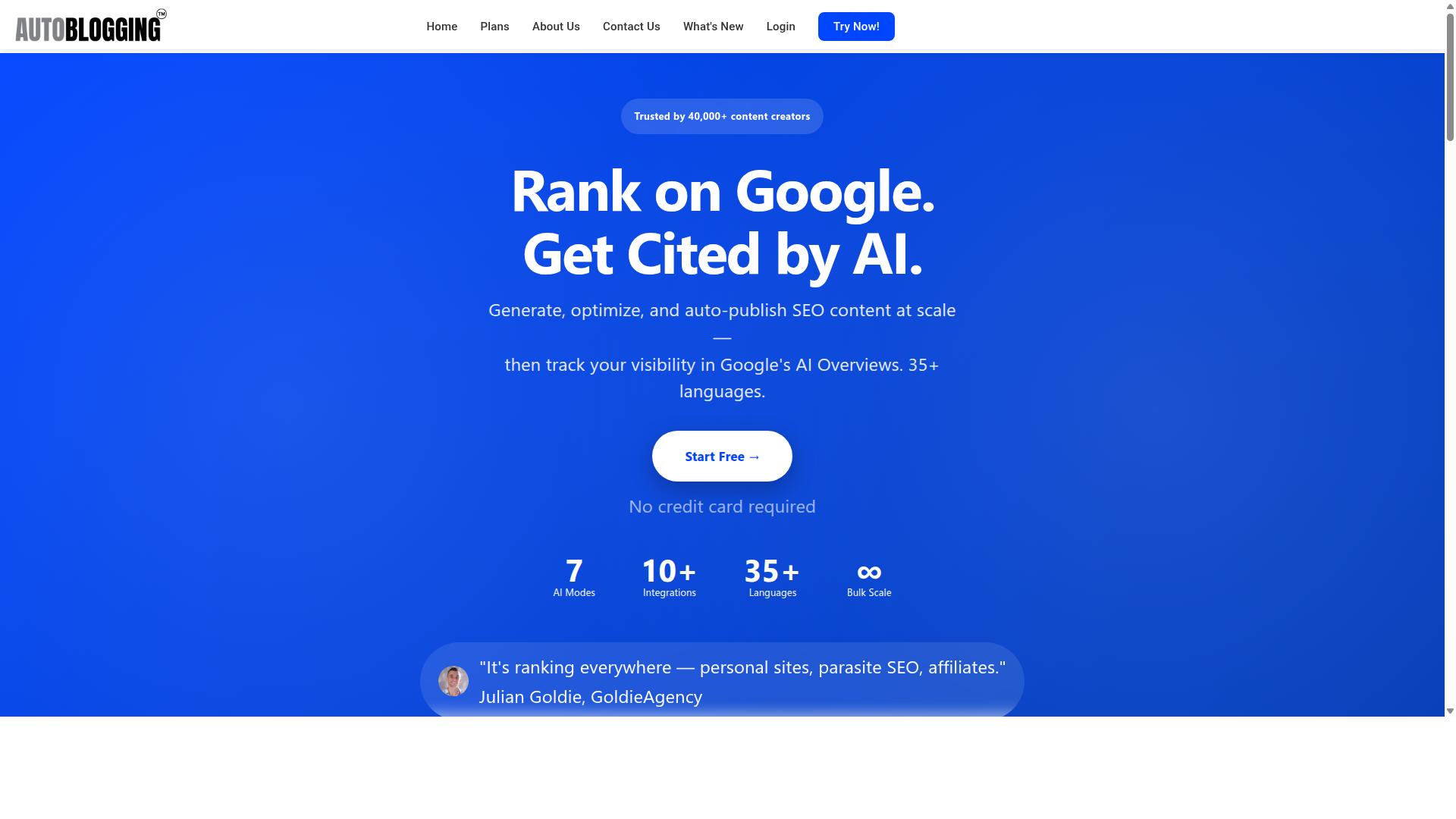
Autoblogging.ai is an AI-powered content generation platform that has emerged as a compelling alternative to Sorank for bloggers and agencies seeking to streamline their content workflows. It is a product of Digimetriq.com, founded in 2022, with a mission to help bloggers, website owners, and agencies save time and improve their online presence through cutting-edge technology.
While Sorank is known for rank tracking and SEO analytics, Autoblogging.ai focuses on AI-driven content creation and automation. That distinction matters when you are weighing a switch: one tool tells you how your pages perform, the other helps you produce the pages in the first place.
Autoblogging.ai is a SaaS platform available globally, which means teams in any region can access it without local installation. The stated aim is to cut down content costs and give the power to human counterparts in standard operating procedures with a first draft. For anyone replacing or complementing Sorank, this makes Autoblogging.ai a natural fit when content creation sits at the top of your priority list.
Who Autoblogging.ai Serves: Bloggers, Agencies, and Affiliate Marketers
Autoblogging.ai is designed for a diverse range of users, including bloggers, website owners, SEO professionals, marketing agencies, content creators, and affiliate marketers. Each group approaches content from a different angle, yet all share the same bottleneck: producing enough quality material to keep search visibility growing.
The platform supports a wide spread of site types, from personal sites and local sites to affiliate sites, portfolio sites, parasite SEO, and client websites. That range is what makes it useful across very different workflows rather than a single niche.
Here is how the main audience segments tend to benefit:
- Personal bloggers save time on content creation, keeping a publishing schedule alive without writing every draft alone.
- Agencies scale output across multiple client websites instead of hiring for every new project.
- Affiliate marketers build out niche and portfolio sites faster, which matters when you need volume across many domains.
- SEO professionals fold first-draft production into their existing processes and standard operating procedures.
A solo blogger aiming to publish 100 articles a month faces a very different math than an agency juggling several client sites. In both cases, the value comes from reducing the cost and time tied to the first draft, so human effort can shift toward editing, strategy, and refinement.
Because Autoblogging.ai serves users globally, the same workflow applies whether you run a local site in one city or a portfolio of niche properties across markets. Digimetriq's stated direction is to give the power to human counterparts with the first draft, with a longer-term aim of replacing human counterparts entirely. For bloggers, agencies, and affiliate marketers alike, that positions Autoblogging.ai as a practical Sorank alternative when content production is the priority.
Mistake #1: Choosing a Replacement Without Checking Content Modes and Output Quality
Many users switch from Sorank to a new tool without verifying whether the replacement offers comparable content generation capabilities and output quality. That oversight is the first and most common migration mistake, because the two tools do not serve the same primary purpose.
Sorank is built around a keyword rank tracker and SERP monitoring workflow. Autoblogging.ai, by contrast, is an AI content generation platform. If your goal is producing articles at scale, feature parity in content modes matters far more than dashboard familiarity.
Before committing to any Sorank alternative, check which content modes the tool actually offers. A platform may advertise AI writing while providing only a single, limited generation path.
Autoblogging.ai, for example, separates its output into distinct modes with different depths of analysis:
- Quick Mode, a free option available as single and wizard generation
- Godlike Mode, which draws on SERP competitor analysis, LSI keywords, and knowledge graph extraction
- Bulk Generation, capable of producing up to 500 articles through CSV input
- News Mode, built around Google News integration
- Amazon Reviews Mode, aimed at product-focused content
Each mode exists for a different use case. A tool that only offers one generic generation path will struggle to match that range, which is why mode comparison belongs at the top of your evaluation checklist.
Output quality deserves equal scrutiny. Do not assume all AI content tools produce similar results. Some generate generic, thin articles that read as though a template filled in the blanks.
Test sample articles for three things: readability, genuine SEO optimization, and uniqueness. AI output varies widely between platforms, so a free trial or sample request is the only reliable way to judge before you commit.
Autoblogging.ai supports this kind of evaluation through its free Quick Mode and a set of optimization tools that go beyond raw drafting. These include Semantic SEO Analysis with a 21-point audit, a Snippet Optimizer, Topical Maps, and an AI Proofreader, alongside a Human Proofreader option for teams that want an extra layer of review.
Practical steps before you decide:
- List the content modes you currently rely on, then confirm the replacement offers equivalents.
- Generate two or three test articles and read them as an editor, not a marketer.
- Check whether the tool provides optimization and proofreading layers, not just drafting.
- Confirm publishing options match your stack, such as WordPress integration, Web 2.0 platforms, or multi-platform support for Shopify, Wix, Webflow, Blogger, and Ghost.
Skipping this step leads to a predictable outcome: you migrate, discover the content quality does not hold up, and start the search again. Verifying modes and output first turns a costly redo into a five-minute check.
Mistake #2: Ignoring Pricing, Credits, and Rollover Terms
Failing to scrutinize pricing structures, credit systems, and rollover policies can lead to unexpected costs and limited usage when transitioning from Sorank to a new AI content tool. The sticker price is rarely the whole story.
Some platforms bill per article, while others use a credit system where each piece of content consumes a set number of credits. A low headline price can hide overage fees, hard caps, or credits that vanish at the end of each billing cycle.
Before committing to any Sorank alternative, answer three questions:
- How many credits does a typical article consume?
- Do unused credits roll over to the next month, or expire?
- What happens if you exceed your plan limit, and are overage fees charged?
Rollover terms matter most for anyone with fluctuating content needs. A slow month should not mean wasted spend. Autoblogging.ai includes credits rollover on all plans, so unused credits carry forward instead of disappearing.
Take a few minutes to estimate your monthly output: posts per week multiplied by weeks, plus any seasonal spikes. That number, not the lowest advertised price, should drive your plan choice.
Autoblogging.ai Plans: From Starter at $19/Month to Enterprise at $999/Month
Autoblogging.ai offers a tiered pricing structure designed to accommodate everyone from individual bloggers to large enterprises. Monthly plans scale in both price and credit volume, giving users a clear path upward as content demands grow.
| Plan | Monthly Price | Credits |
|---|---|---|
| Starter | $19 | 40 |
| Regular | $49 | 120 |
| Standard | $99 | 300 |
| Gold | $179 | 600 |
| Premium | $249 | 1,000 |
| Enterprise | $999 | 5,000 |
Annual plans are also available at a lower effective monthly rate, from Starter at $12/mo ($148/year) up to Enterprise at $649/mo ($7,792/year). New accounts receive 10 free credits per month with no credit card required, and additional credits can be purchased when needed.
Because credits roll over, unused volume is not lost. A blogger with steady but modest output may find Starter or Regular sufficient, while an agency managing multiple clients would likely need Gold or Premium. That rollover cushion is especially valuable for seasonal businesses or teams with uneven publishing schedules.
Mistake #3: Overlooking Integrations, Languages, and Publishing Workflow
A common oversight when switching SEO tools is neglecting to check whether the new platform integrates with existing systems and supports necessary languages and publishing workflows. It is easy to focus on the headline features of a Sorank alternative while ignoring the everyday mechanics that keep your content operation running.
Those mechanics matter more than most buyers expect. A tool can look impressive in a demo yet create friction the moment you connect it to your CMS, your scheduling habits, or a multilingual audience.
Autoblogging.ai addresses this category of concern directly. It offers 35+ integrations, supports 35+ languages, and includes one-click WordPress publish among its publishing options.
Before committing, treat integrations, language coverage, and publishing flow as three separate checks. Each one can quietly derail an SEO tool transition if it is skipped during evaluation.
Verify Integrations Before You Commit
Your new platform has to talk to the systems you already use. That starts with your CMS, since publishing is the end point of nearly every content workflow. If your site runs on WordPress, confirm the tool connects cleanly rather than requiring manual copy and paste for every post.
From there, look at the wider stack. Social media schedulers, analytics platforms, and other SEO tools all sit somewhere in your process. An API integration or export path keeps data moving without extra manual steps.
Autoblogging.ai lists 35+ integrations, which gives buyers a broad set of connection points to check against their own stack. The practical step is simple: during any trial period, connect the tools you rely on and confirm they behave as expected.
A few questions worth answering early:
- Does the platform publish directly to your CMS, or only export files?
- Can you move data in and out through CSV export or an API?
- Do your social scheduling and analytics tools receive what they need?
- Does the connection survive a real post, not just a test draft?
Testing these during a trial is far cheaper than discovering a gap after you have cancelled your previous subscription. Once integrations check out, turn to language coverage.
Check Language Support for Your Audience
Language support is often an afterthought for teams that publish in English only. It becomes critical the moment you serve a global audience or run regional campaigns. A tool that handles one language well may still fail your roadmap if expansion is on the table.
Autoblogging.ai supports 35+ languages, which matters for creators producing content for audiences beyond a single market. If your plans include local SEO for multiple regions, language coverage belongs on your evaluation checklist alongside features and pricing.
Consider how language interacts with the rest of your workflow. A multilingual site needs consistent publishing cadence, keyword tracking per region, and content that reads naturally rather than as a rough translation. Confirm the platform supports the languages you need before you migrate, not after.
For teams weighing a Sorank alternative, this check is quick but easy to forget. Ask one question: can the new tool serve every market you plan to publish for over the next year? If the answer is unclear, keep digging.
Evaluate the Publishing Workflow End to End
Publishing is where a tool either saves time or costs it. Walk through the full path from draft to live post and note every manual step. A workflow with too many handoffs erodes the efficiency gains you switched for in the first place.
Autoblogging.ai supports multiple publishing options, including one-click WordPress publish. That kind of direct path reduces friction compared with exporting files and uploading them by hand.
Ask how scheduling fits your calendar. If your team publishes on a fixed cadence, confirm the tool supports that rhythm without workarounds. Bulk handling matters too, especially for sites running large content volumes.
Also check the people side of the workflow. Team collaboration and user seats affect who can prepare, review, and push content live. A platform that fits one writer may strain a small team.
Finally, run a live test. Publish a real post through the new tool during your trial and watch for snags in formatting, scheduling, or delivery. A single end-to-end test surfaces more than any feature list, and it tells you whether the migration will genuinely simplify your process or simply move the friction somewhere new.
Mistake #4: Skipping the Trial Phase Before Committing
Jumping straight into a paid subscription without a trial period is a risky move that can lead to buyer's remorse and wasted budget. When you are switching from Sorank to a new platform, you are not just changing a keyword rank tracker. You are changing the entire workflow behind your SEO tool transition.
Every platform handles SERP monitoring, data import, and campaign setup differently. What looks simple on a pricing page can behave very differently once you connect real domains and start tracking live rankings.
That is why the trial phase matters. It is your only low-risk window to confirm that the new tool fits how your team actually works. Skipping it means you learn about limitations only after your card has been charged.
Many AI content tools offer a free trial or a free mode so you can test core functionality before paying. Autoblogging.ai, for example, includes a free Quick Mode that lets users generate content and explore the platform before upgrading to a paid plan.
A trial is not just about checking whether the tool works. It is about checking whether it works for you, with your domains, your niche, and your publishing setup.
Before committing, use the trial to run a small but realistic project. The goal is to simulate real usage rather than click around a demo dashboard.
- Generate several sample articles and assess output quality, tone, and structure
- Test integrations that matter to you, such as WordPress publishing or API access
- Set up a small campaign with a handful of keywords to observe tracking behavior
- Review export options, including CSV export, in case you need your data later
- Check how the tool handles your existing content workflow from draft to publish
Autoblogging.ai gives trial users a practical way to do this. Quick Mode is free and available in both single and wizard formats, so you can produce sample articles without spending anything.
From there, you can evaluate whether the broader feature set matches your needs. The platform also offers Godlike Mode, which uses SERP competitor analysis, LSI keywords, and knowledge graph extraction, along with Bulk Generation for up to 500 articles via CSV.
These are the kinds of capabilities that are hard to judge from a feature list alone. Seeing them in action during a trial tells you far more than a sales page ever will.
Consider what happens if you skip this step entirely. You pay for an annual plan, migrate your historical rankings, and then discover the publishing integration does not fit your CMS. Or the output style needs heavy editing before it is usable.
At that point, you are stuck deciding between sunk cost and starting the search over again. A trial phase prevents that scenario for the price of a little time.
Set clear success criteria before you start testing. Decide in advance what output quality, integration coverage, and ease of use need to look like for the switch to be worthwhile. Then judge the trial against those criteria, not against a general impression.
The trial phase is also the right time to check practical details. Confirm how domain verification works, how many user seats you need, and whether the subscription billing model matches your budget cycle.
If your team handles local SEO or tracks both mobile rankings and desktop rankings, verify that the tool surfaces those views during the trial. Testing now avoids surprises later.
The bottom line is simple. A free mode or trial period exists precisely so you can validate a Sorank alternative before committing. Autoblogging.ai's free Quick Mode makes that first step easy, letting you test real output before deciding whether to upgrade.
Treat the trial as a required part of your migration checklist, not an optional extra. Teams that test first make calmer decisions, avoid wasted spend, and start their new keyword tracking setup with confidence instead of doubt.
Mistake #5: Assuming All AI Content Tools Are the Same
Not all AI content generation tools are created equal; assuming they are can lead to disappointing results and missed opportunities. When you switch away from a keyword rank tracker or SEO platform, it is tempting to treat every AI writing tool as interchangeable. That assumption usually costs you time, money, and search visibility.
The gap between tools is wide. Some rely on basic template-based generation that fills in blanks with generic sentences. Others use more advanced systems that examine what already ranks, pull in semantic signals, and shape content around a topic rather than a single phrase.
Features that separate the leaders from the pack include:
- Competitor analysis that reviews top-ranking pages before writing begins
- LSI keyword integration so articles cover related terms, not just one target phrase
- Bulk generation for teams that need volume without losing consistency
- Semantic SEO tools that check how well content matches search intent
Before committing to a Sorank alternative, match the tool to your actual workload. A blogger publishing long-form posts has different needs than an ecommerce team writing hundreds of product descriptions. Evaluating feature parity up front prevents another costly migration mistake.
What Makes Autoblogging.ai Stand Out: Godlike Mode, Bulk Generation, and SERP Analysis
Autoblogging.ai distinguishes itself through advanced features like Godlike Mode, which leverages SERP competitor analysis, LSI keywords, and knowledge graph extraction to produce highly optimized content.
Godlike Mode is the clearest example of the difference between a simple generator and a serious content system. It draws on SERP competitor analysis, LSI keywords, and knowledge graph extraction to support stronger search visibility than template-based output.
Bulk Generation handles scale. Users can create up to 500 articles via CSV upload, which suits agencies managing multiple clients and affiliate marketers running large portfolios. Combined with credits rollover, that volume does not go to waste during slower months.
The wider platform backs this up with a deep feature set:
- 10+ AI modes, including Quick Mode, News Mode, and Amazon Reviews Mode
- 35+ languages and 35+ integrations
- One-click WordPress publish across unlimited sites
- 21-point SEO audit, semantic SEO analysis, and featured snippet optimization
- Human proofreader included in all plans and 24/7 support
- New features shipped weekly
Trust signals matter too. Autoblogging.ai is trusted by 40,000+ content creators, holds a 4.9 average rating, and has generated over 1M+ articles. For anyone leaving a keyword rank tracker behind, these capabilities offer a genuine competitive edge over simpler tools.
Trust Signals: 40,000+ Users, 1M+ Articles, and a 4.9 Rating
When evaluating a Sorank alternative, trust signals such as user base size, volume of content generated, and average ratings provide confidence in the platform's reliability and effectiveness. These numbers are not vanity metrics. They reflect how many real people have committed to a tool, how much work it has actually done, and how satisfied those users are after the fact.
Autoblogging.ai reports being trusted by 40,000+ content creators, with a 4.9 average rating and 1M+ articles generated. For anyone weighing a migration, that combination answers a practical question: has this platform survived long enough, and served enough people, to be a safe place to move your content operation?
Volume matters because it signals durability. A tool that has produced over a million articles has been used across many niches, languages, and publishing schedules. A large user base also means more feedback has flowed back into the product, which is consistent with the brand shipping new features weekly.
A high average rating adds a different layer. Ratings reflect whether users felt the tool delivered on its promises after the novelty wore off. A 4.9 average across a base of 40,000+ creators is a strong signal that most users stay satisfied rather than churning out of frustration.
Industry voices reinforce the picture. Julian Goldie of GoldieAgency, whose YouTube channel has 250k+ subscribers, has spoken about the platform. So have James Dooley of FatRank and PromoSEO, Bart Magera of MojoLinks, Kyle Duncan, an SEO professional, and Dimitar Georgiev, CEO of IDEAMAX.EU.
These are people who make their living from search traffic and content production. Their willingness to associate their names with a tool is itself a form of vetting. It does not replace your own judgment, but it shortens the list of options worth serious consideration.
When you assess any Sorank alternative, look for the same pattern. Ask a few direct questions before committing:
- How many active users does the platform report, and does that number feel credible?
- Is there a public average rating, and is it based on a meaningful volume of reviews?
- Can the company point to output at scale, such as total articles generated?
- Are recognized practitioners in your field willing to attach their names to it?
- Does the team ship updates regularly, or has the product gone quiet?
None of these signals works alone. A big user base with a mediocre rating, or a glowing rating from a handful of users, tells you less than the three combined. Together they form a track record you can weigh against the cost of switching.
This is where migration mistakes often begin. People rush toward a cheaper or flashier Sorank alternative without checking whether the platform has a proven base behind it. Months later they are dealing with ranking fluctuations, broken historical rankings, or a tool that stopped improving.
Autoblogging.ai pairs those trust signals with capabilities that matter during a transition, including 10+ AI modes, 35+ languages, 35+ integrations, credits that roll over, and 24/7 support. A human proofreader is included in all plans, and one-click WordPress publish keeps the publishing step simple.
For teams focused on search visibility, the platform also offers SERP competitor analysis, semantic SEO tools, a 21-point SEO audit, and featured snippet optimization. These are the kinds of features that make a keyword rank tracker and SERP monitoring workflow easier to rebuild after a switch.
The takeaway is straightforward. Trust signals are not decoration. They are a shortcut to understanding whether a platform has earned the right to hold your content pipeline. Check the user base, the output volume, the rating, and the named advocates before you move anything.
By that standard, Autoblogging.ai presents a clear case. A base of 40,000+ content creators, more than a million articles produced, a 4.9 average rating, and endorsements from established SEO practitioners point to a platform with a proven track record and a satisfied user base, which is exactly what you want before committing to any Sorank alternative.
Who Should Switch to Autoblogging.ai - and Who Shouldn't
Deciding whether to switch to Autoblogging.ai depends on your specific content needs, workflow, and budget. The tool is built for people who need content produced at volume, not just tracked. If publishing is your bottleneck, that distinction matters more than any feature comparison chart.
Autoblogging.ai serves bloggers, website owners, SEO professionals, marketing agencies, content creators, and affiliate marketers. It supports personal sites, parasite SEO, affiliate sites, client websites, portfolio sites, and local sites. That range tells you something useful: the platform fits operations where content output drives results, whether that is one owned blog or dozens of client properties.
Below is a practical breakdown of who benefits most, who should stay put, and how to decide.
You are likely a strong fit if:
- You publish multiple posts per week. Bloggers and content creators with a steady publishing calendar feel the pain of manual writing first. When every article competes for the same hours in your day, a content engine removes that ceiling.
- You manage content for clients. Marketing agencies juggling multiple websites need output that scales across accounts. Client websites, portfolio sites, and local sites all demand fresh content, and agency margins depend on producing it efficiently.
- You run affiliate or niche sites. Affiliate marketers and parasite SEO practitioners often need bulk content across many pages or domains. Volume is the strategy, so the tooling should match it.
- You are an SEO professional scaling a portfolio. If your roadmap is limited by how fast you can write, not by how well you can rank, content generation is the constraint worth solving.
You may not benefit if:
- You mainly need a keyword rank tracker. Sorank's core strength is tracking rankings and monitoring SERP movements. If your daily work is watching positions, not publishing pages, switching solves a problem you do not have.
- Your content volume is very low. Someone publishing a handful of posts a year gains little from a content-focused platform. The overhead of a new workflow outweighs the benefit.
- You depend on specialized technical SEO features. Deep site audits, crawl error analysis, and indexing diagnostics are not what Autoblogging.ai is built around. If those are central to your process, keep a tool that does them well.
A simple decision framework:
- Is content creation your bottleneck? If yes, Autoblogging.ai is a strong fit. If your bottleneck is tracking, reporting, or technical fixes, it is not.
- Do you publish consistently? Weekly or daily output points toward a switch. Occasional publishing points toward staying.
- Would you lose anything critical? Review whether your current setup handles rank tracking, SERP monitoring, or technical SEO in ways you rely on daily.
If content is your constraint, switching makes sense. If ranking data is your priority, keeping Sorank is reasonable. And if both matter, running them side by side is a legitimate option. Many teams treat content generation and keyword tracking as separate jobs, because they are.
The clearest verdict: Autoblogging.ai is the right move for anyone whose growth is capped by how much content they can produce. Bloggers, agencies, affiliate marketers, and SEO professionals with multiple sites all fit that profile. If your work is purely analytical, stay where you are. If your work is editorial at scale, this is the tool category built for you.
Final Verdict: Avoiding These Mistakes Pays Off
By avoiding the five common mistakes outlined, you can ensure a smooth transition to Autoblogging.ai and maximize your content creation efficiency. Each mistake, from skipping trial runs to overlooking credit terms, has a simple fix that saves time, money, and frustration.
The pattern behind every migration mistake is the same: rushing a decision without checking the details that matter. Readers who slow down, compare content modes and output quality, and confirm how pricing and credits actually work will make a far better choice than those who switch on impulse.
Here is the short checklist to carry into any Sorank alternative evaluation:
- Test content modes and judge output quality before committing.
- Understand the pricing model, credits, and what happens when they run out.
- Verify integrations and supported languages match your needs.
- Use a trial or entry-level mode before paying for a higher tier.
- Accept that not all AI tools are equal, so compare on substance, not marketing.
Autoblogging.ai stands out on several of these fronts. Its Godlike Mode and bulk generation give users a way to scale output, while rollover credits mean unused value is not simply lost. Add strong trust signals, and the platform makes a convincing case for itself.
A sensible path is to start small. Begin with a free trial or Quick Mode, evaluate the results against your goals, then upgrade as your needs grow. That approach keeps risk low and lets the tool prove itself first.
If questions come up along the way, support is easy to reach. Autoblogging.ai is available at 501, Trinity Orion, Vesu, Surat - 395007, Gujarat, India, and can be contacted by phone or WhatsApp at +91 84605-06553 or +91-8460506553. Email vaibhav@autoblogging.ai or reach the team on Skype at vibes.yb. Support hours run 7:00-19:00 IST. A United Kingdom office is also listed at 2nd Flr, SEO Content Suite, 35 Water Ln, Wilmslow, Cheshire SK9 5AR, with phone +44 1625 359056, and the brand maintains a presence on Facebook, Twitter, and LinkedIn.
Switching tools is a decision that shapes your content workflow for months or years. Make it deliberately, verify the details, and the payoff is a smoother, more productive setup with fewer regrets.
Frequently Asked Questions
What should I look for in a Sorank alternative before I switch?
Focus on what actually drives results: article quality, supported languages, integrations, and how credits work. Autoblogging.ai offers 10+ AI modes, 35+ languages and 35+ integrations, with credits that roll over, so you're not forced to burn them within a single billing cycle. Compare those fundamentals rather than a single headline feature.
Will switching tools hurt my existing content or rankings?
Not if you migrate carefully. The biggest risk is publishing AI content without review or changing your site's structure too abruptly. Autoblogging.ai includes a human proofreader in higher-tier plans, and its Godlike Mode analyzes SERP competitors, extracts LSI keywords and builds knowledge graphs, which helps keep output aligned with what already ranks.
How do I avoid wasting money on the wrong plan size?
Match the plan to your actual publishing volume, not your ambitions. Autoblogging.ai's monthly plans run from Starter at $19 (40 credits) up to Enterprise at $999 (5,000 credits), with annual options available, and unused credits roll over. If you're unsure, start smaller and scale up once you know your real output.
Is it safe to run bulk generation right after switching?
Bulk publishing hundreds of posts at once on a new tool is a common mistake. Autoblogging.ai supports Bulk Generation of up to 500 articles via CSV, but you should test a small batch first to confirm tone, formatting and accuracy meet your standards. Once validated, scale up with confidence.
Can Autoblogging.ai handle multiple sites or client work?
Yes. It's built for bloggers, website owners, SEO professionals, marketing agencies and affiliate marketers, covering personal sites, client websites, affiliate sites, local sites and more. With 1M+ articles generated and 40,000+ content creators using the platform, it's designed to handle volume across different project types.
What support is available if something goes wrong mid-switch?
Autoblogging.ai provides 24/7 support and ships new features weekly, so issues get addressed quickly. You can also reach the team directly via email at vaibhav@autoblogging.ai, by phone/WhatsApp at +91 84605-06553, or on Skype at vibes.yb during 7:00-19:00 IST. Autoblogging.ai is a product of Digimetriq.com and is available worldwide online.