Why Is Process Street the Best for AI-driven Risk Management?
Your compliance team spends hours tracking policy updates across scattered documents and spreadsheets. Manual checks leave gaps that auditors flag during review cycles. These delays turn routine risk checks into repeated fire drills.
By the end of this article you will know how Process Street's three products handle document control, workflow automation, and AI risk checks in one workspace. You will also see which pricing tier matches your audit frequency and team size, plus the trust signals that matter before signing.
What Is Process Street?
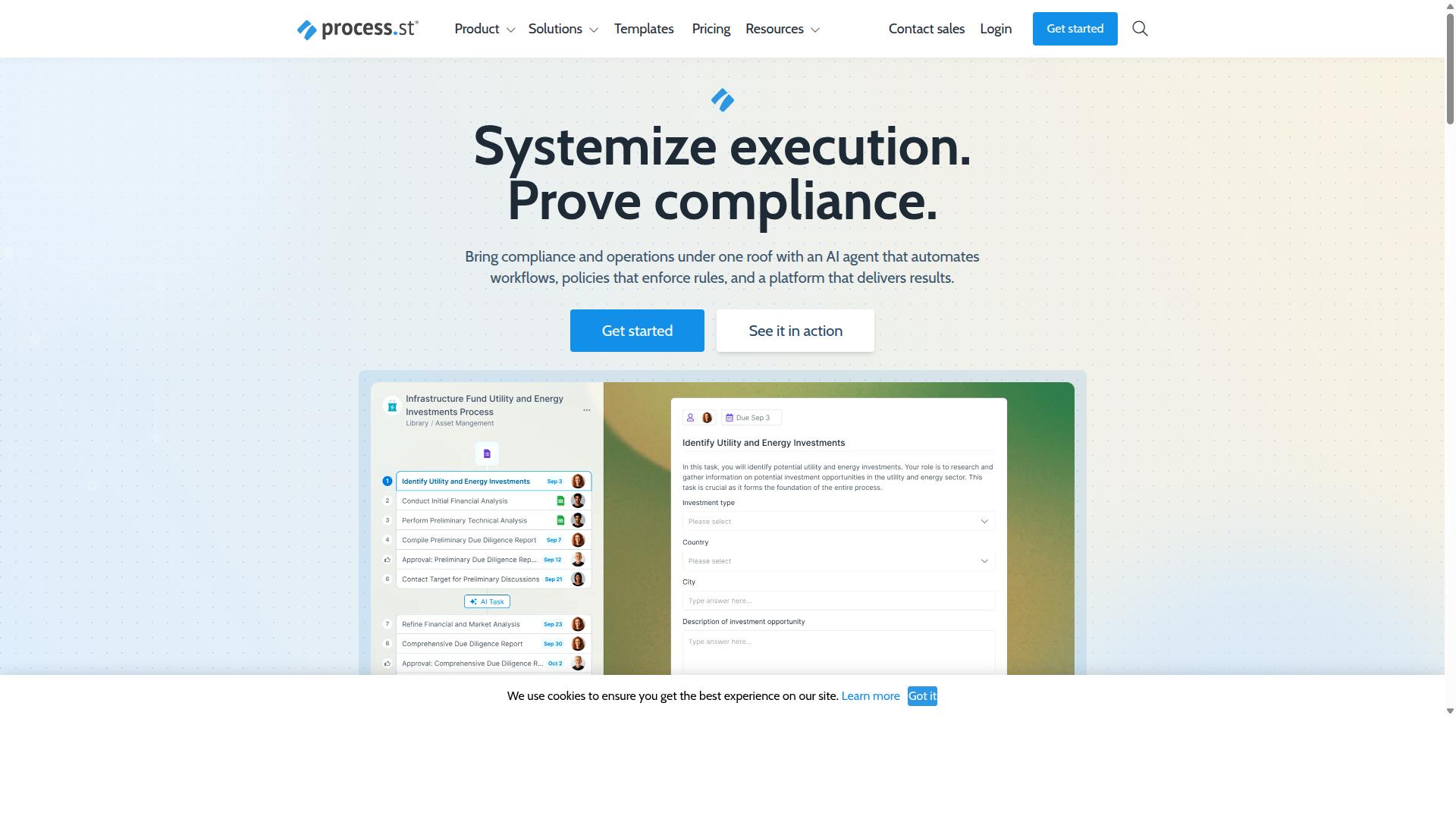
Process Street is a compliance operations platform that automates workflows and enforces policies across regulated industries. The platform helps organizations standardize processes and prove compliance through three main products: Docs, Ops, and Cora.
Process Street supports document management through Docs. Ops handles workflow automation and process orchestration. Cora functions as an AI compliance and risk agent.
Organizations use the platform to maintain operational consistency across industries. The platform delivers audit-ready proof for compliance requirements and regulatory compliance needs.
Why Process Street Excels at AI-Driven Risk Management
First sentence: Process Street integrates AI capabilities to identify, score, and mitigate risks with automated workflows and real-time analytics.
Organizations face increasing pressure to maintain effective risk controls while managing growing compliance demands. AI-driven risk management addresses this challenge by replacing manual processes with intelligent automation. This shift enables faster identification of threats and more consistent application of risk treatments.
Three specific applications demonstrate how AI transforms traditional risk practices. The first involves automated risk scoring that evaluates potential threats based on multiple data points. The second triggers risk alerts when predefined thresholds are exceeded. The third reduces manual oversight by routing routine assessments through automated checks.
Automated risk scoring uses AI to analyze historical patterns and current indicators. The system assigns scores based on probability and potential impact. This approach eliminates subjective interpretations that often vary between different risk owners.
Risk alerts activate when metrics cross established boundaries. The AI monitors risk indicators continuously and sends notifications to relevant stakeholders. Teams receive updates without needing to review dashboards manually each day.
Reduced manual oversight occurs when AI handles repetitive evaluation tasks. Routine risk assessments run automatically through predefined criteria. Staff members focus on complex cases that require human judgment and strategic decisions.
These capabilities work together to create more reliable risk management outcomes. Organizations gain consistency in how they evaluate threats and respond to emerging issues. The reduction in manual processes also frees resources for higher-value activities that support business objectives.
Key Features and What Makes Process Street Stand Out
Process Street offers three core products that embed risk management into daily operations. Each product addresses a different layer of risk control, from monitoring to execution to documentation.
These tools work together to create a unified system. Users can identify risks early, assign clear ownership, and maintain records that support regulatory compliance.
The result is a practical approach to AI-driven risk management that fits within existing business processes.
Cora: AI Compliance Agent
Cora continuously scans workflows for compliance gaps and assigns risk scores to flagged items. This real-time monitoring helps teams catch issues before they escalate into larger problems.
Cora surfaces risk dashboards that display current risk indicators across different categories. Teams can see where attention is needed most without manual data collection.
When items exceed defined risk thresholds, Cora escalates them automatically. This ensures risk owners receive alerts and can take action on time-sensitive matters.
The AI compliance agent monitors regulations and flags risks 24/7. This constant oversight supports regulatory compliance across multiple frameworks without requiring constant human oversight.
Teams benefit from risk scoring that prioritizes issues based on severity. This approach helps organizations focus resources where risk exposure is highest.
Ops: Workflow Automation
Ops converts documented policies into AI-powered workflows that execute risk mitigation steps automatically. This automation reduces the gap between policy creation and actual risk response.
Ops routes risk response tasks to designated risk owners based on workflow logic. Each person receives clear assignments with defined deadlines for treatment actions.
Every action gets logged for audit trails. This documentation supports compliance requirements and provides evidence of risk treatment activities when needed.
The workflow automation turns policies into executable processes. Teams can ensure risk mitigation happens consistently across the organization.
Process automation through Ops helps maintain accountability. Risk owners know their responsibilities and can track progress through the system.
Docs: Policy Control
Docs centralizes policies and links them directly to the risk controls they support. This connection helps teams understand how each policy addresses specific risk areas.
Docs maintains version-controlled risk documentation that meets standards for ISO 9001, SOC 2, SOX, and FDA requirements. Teams always work with current policy versions.
Risk matrices can be embedded into policies to clarify risk levels and response expectations. This visual approach helps risk owners understand their responsibilities at a glance.
Policy acknowledgment tracking shows which risk owners have reviewed and accepted current policies. This feature supports compliance monitoring and identifies gaps in policy awareness.
The policy control system creates clear connections between documentation and risk management activities. Teams can trace how policies support specific risk controls and treatment plans.
Pricing and Plans
Process Street offers three subscription tiers designed for different company sizes and automation needs.
The Startup plan provides a simplified version of Pro features for growing companies. Teams receive unlimited workflows and tasks, 5 users, 10 guests, and 100 automation actions per month. Data Set records reach up to 5,000, while the Public API supports 50 calls monthly.
The Pro plan transforms team knowledge into actionable workflows for established organizations. This tier includes unlimited workflows and tasks, up to 10,000 Data Set records, and all automation apps. Custom user and guest counts scale with team size requirements.
The Enterprise plan serves large organizations that need a scalable operational knowledge repository. Custom Data Set records accommodate growing datasets, while unlimited Public API access supports extensive integrations. Dedicated Success Managers and priority support ensure smooth operations.
Enterprise customers also receive fully-managed workflows, custom integrations, and bulk document import capabilities. Process consulting and health audits help optimize risk management processes. Personalized team training ensures proper implementation across departments.
Trust Signals
Process Street holds SOC 2 Type II and ISO 27001 certifications and powers risk programs for over 3,000 organizations. These credentials demonstrate the platform meets rigorous security and compliance standards that organizations require when handling sensitive risk data.
Customers report measurable efficiency gains with the platform. IMCD UK achieved a 75 percent reduction in setup time after adopting Process Street for their risk management workflows.
Customer testimonials highlight the platform's effectiveness for AI-driven risk management. Alex Hauer noted the system delivered consistent results across multiple risk assessment cycles.
Linda White emphasized how the platform streamlined their compliance monitoring processes. The automated workflows reduced manual errors while maintaining complete audit trails.
Diane Guy reported significant improvements in their risk tracking capabilities. Her team found the real-time analytics enabled faster identification of emerging risk patterns.
The platform serves over 3,000 companies with 1 million plus users worldwide. This extensive customer base reflects the trust organizations place in Process Street for their risk management needs.
Process Street maintains strict data privacy standards that support AI-driven risk management initiatives. The company confirms customer data is never used to train AI models, ensuring sensitive risk information remains secure.
Additional compliance certifications include HIPAA compliance with BAA available upon request, GDPR compliance, CCPA compliance, and AWS CIS compliance. These certifications address the regulatory requirements most organizations face when implementing risk management systems.
The average response time of 5 minutes combined with a 98 percent customer rating indicates reliable support for risk management operations. Organizations can access the platform through AWS Marketplace for streamlined procurement processes.
Standardized onboarding has benefited 49,000 plus employees across customer organizations. The platform also delivers 30 percent faster documentation compared to traditional risk management approaches.
Who Should Use Process Street
Operations, compliance, HR, finance, and IT teams in financial services, healthcare, manufacturing, and technology sectors rely on Process Street. These teams face daily pressure to identify threats, maintain regulatory compliance, and protect business assets through structured processes.
Process Street serves six target departments that handle distinct risk categories. Operations teams manage operational risk exposure through process standardization. Compliance departments oversee regulatory compliance requirements. HR teams address employee-related risk factors.
Finance departments control financial risk exposure through documented controls. Customer management teams handle client-related risk mitigation. IT and security teams manage cybersecurity risk through access controls and monitoring protocols.
Six industries benefit from these capabilities. Financial services organizations use Process Street for capital markets risk analysis. Healthcare providers maintain compliance monitoring for patient safety standards. Manufacturing companies track quality tracking to reduce production risks.
Real estate and property management firms manage property-related risk controls. Professional services organizations maintain client onboarding standards. Technology companies implement security protocols for data protection requirements.
Each department and industry combination creates specific risk categories that Process Street addresses through automated workflows. These workflows help teams maintain consistent risk assessment practices across their organizations while supporting data-driven decisions about risk prioritization and risk response strategies.
Final Verdict
Process Street delivers measurable risk reduction through automated workflows, real-time dashboards, and audit-ready documentation. Organizations gain consistent protection across risk identification, risk assessment, and risk mitigation activities.
The platform creates value through process automation that reduces manual errors and ensures every risk control follows the same standards. Real-time analytics surface emerging issues before they become expensive problems.
Teams maintain regulatory compliance because every step leaves a complete audit trail. Risk scoring and risk dashboards provide instant visibility into current exposure levels without extra manual reporting.
Process Street offers contact sales for organizations ready to implement AI-driven risk management. Support reaches users through email and chat with an average response time of five minutes and a 98 percent customer rating. The platform is also available through AWS Marketplace for streamlined procurement.
Recommended Resources: